The Thompson Children by John Carlin
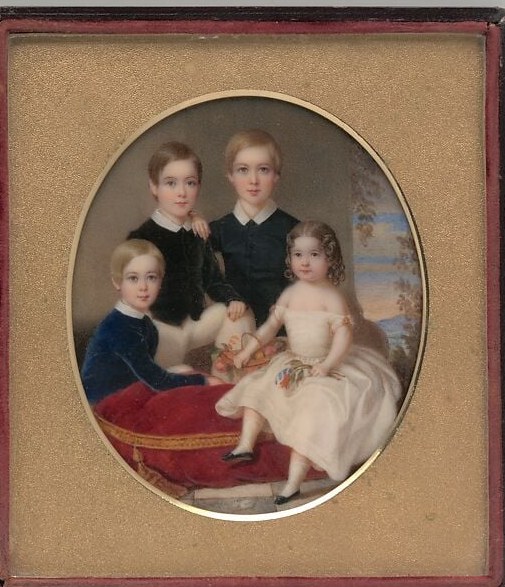
This is The Thompson Children, a watercolor miniature painted on ivory by John Carlin in 1846. It lives at the Metropolitan Museum of Art, and it holds a secret most viewers miss: the ground itself is doing half the work.
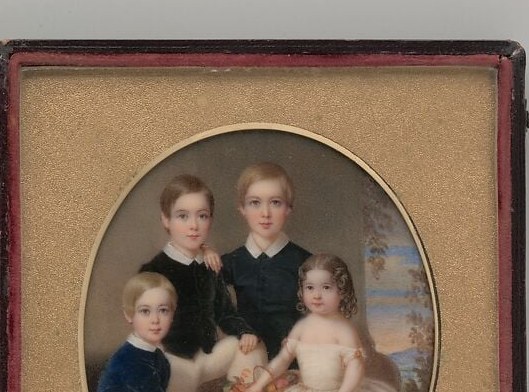
The children's faces glow. That isn't a trick of pigment alone. Ivory is translucent. Paint a skin tone on paper and the light dies at the surface; paint the same wash on ivory and the light passes through, hits the white beneath, and comes back. Flesh tones in miniature portraiture have an inner radiance for exactly this reason. Look at the smooth, almost porcelain quality of their cheeks, that is the ivory support lighting them from below.
John Carlin was born deaf in Philadelphia in 1813. He became a painter of portraits and genre scenes, an illustrator, and the first published deaf poet in the United States. His arrangement of these three children follows strict Victorian hierarchy, the eldest boy set highest and centered, the younger siblings flanking below, but a painter who lived in visible silence may have understood something particular about how stillness reads. The children are stiff and solemn, dressed like small adults, as convention demanded.
Miniature portraits on ivory were intimate objects, meant to be held in the hand, opened in private, carried close. Already by the 1850s, daguerreotypes were replacing them. This painting was made at the very end of a tradition. The red velvet lining of its case tells us someone treasured it enough to keep it safe through nearly two centuries of photography, film, and screens.
Details
Transcript
Three children, dressed for a portrait in the 1840s. The artist was John Carlin, America's first published deaf poet. He arranged them in a careful hierarchy: tall, short, tall. Their faces are painted on ivory, not paper. Ivory is translucent. Light passes through the paint and reflects back. That's why their skin glows from within, a trick no other ground can do. Within ten years, photography would make this technique a lost art.