Eaton's Neck, Long Island by John Frederick Kensett
Eaton's Neck, Long Island is one of John Frederick Kensett's final paintings, completed in 1872, the year he died. It captures a stretch of Long Island's north shore at a moment just before the Gilded Age transformed the coastline into the Gold Coast of country estates. The painting belongs to the Metropolitan Museum of Art, an institution Kensett himself helped to found.
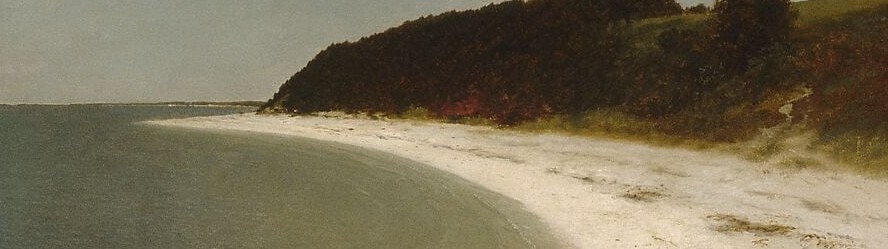
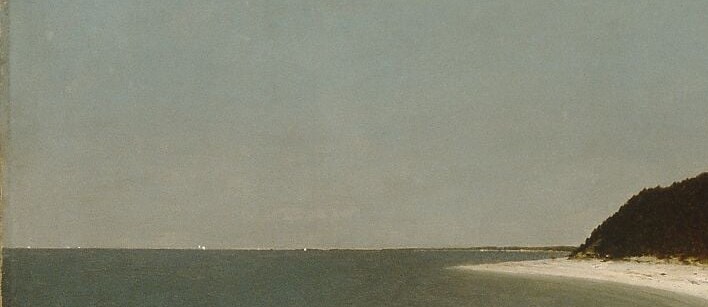
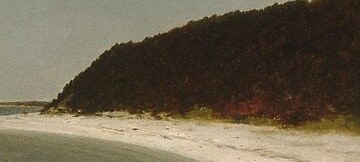
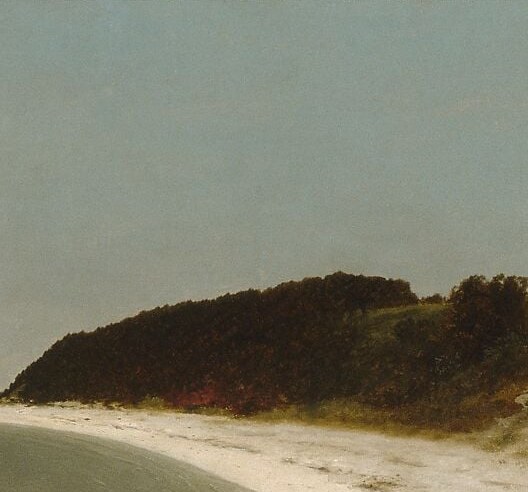
What first appears as a simple study of sand and water rewards sustained looking. The wet strip of beach in the foreground catches the light differently than the dry sand above it. The dark reflection of the headland doubles the landmass in the water, and the nearly imperceptible haze on the horizon dissolves the boundary between sea and sky. Kensett's technique makes the air itself visible.
Kensett was a leading figure of the Hudson River School's second generation. By the 1860s his work had shed dramatic narrative in favor of what became known as Luminism: a spare, meditative style built on subtle gradations of light across still water and pale sky. This painting is the style distilled to its essence. A few small boats rest near the shore, but the real subject is the atmosphere and the quiet.
This is a landscape that knows its own transience. The painter died the year it was finished, and the undeveloped coast he loved would soon be sold off in parcels for the great estates. The painting remains as a direct witness to a vanished place.
Details

Transcript
Before the Gold Coast mansions, this was Eaton's Neck. The painter recorded a shoreline about to be erased. A few small boats rest near the shore. The water is so still it reads as polished metal. He finished this painting in 1872, the year of his death. It is a landscape of profound, deliberate silence.