View of Poestenkill, New York by Joseph H. Hidley
Joseph H. Hidley's "View of Poestenkill, New York," painted around 1870, is a panoramic record of a single upstate town by a self-taught artist who never left it. Hidley was a local house painter and woodworker who made these bird's-eye views for his neighbors. He painted on wood panels rather than canvas, which gave him an unusually smooth, almost enameled surface to work with.
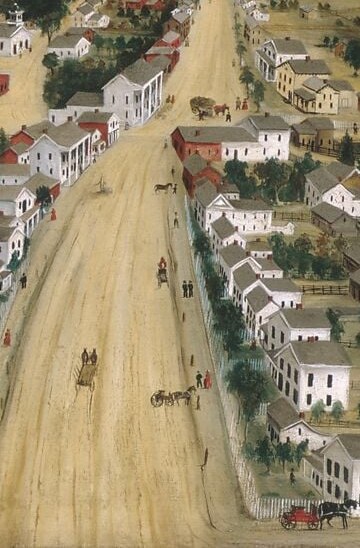
Notice the complete absence of weather in the sky: no clouds, no haze, just a flat cream light. The trees along the road and the left margin are built as rounded dark globes, a signature folk-art solution to rendering foliage that repeats consistently across the entire scene. Everything is front-facing. He gives every house equal billing, lining them up like civic actors on a stage.
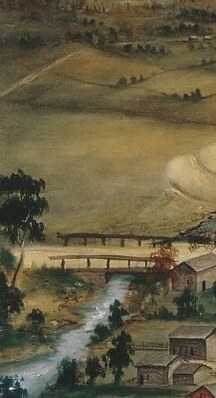
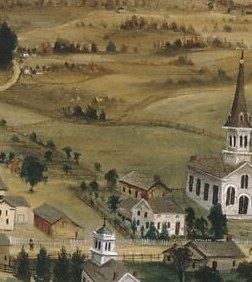
From the right side of the road, the tall white steeple of the church anchors the composition. That church is still standing today in Poestenkill, making this painting a living map across a hundred and fifty years. The winding creek on the left is almost certainly the Poestenkill itself, the waterway that powered the town's mills and gave the place its name.
Hidley died in 1872, only two years after likely completing this work. He left fewer than a dozen known paintings, each of them a self-invented system for solving the same problem: how to show an entire community, true and complete, from a single fixed point.
Details


Transcript
The sky has no clouds. No weather at all. That pale emptiness is the first clue this is a different kind of picture. Look at the trees. Every green crown is a perfect lollipop globe. Joseph Hidley never went to art school. He just painted his town the way he knew it: building by building, road by road. And that white church still stands. You can go stand exactly here.