Green River Cliffs, Wyoming by Moran, Thomas
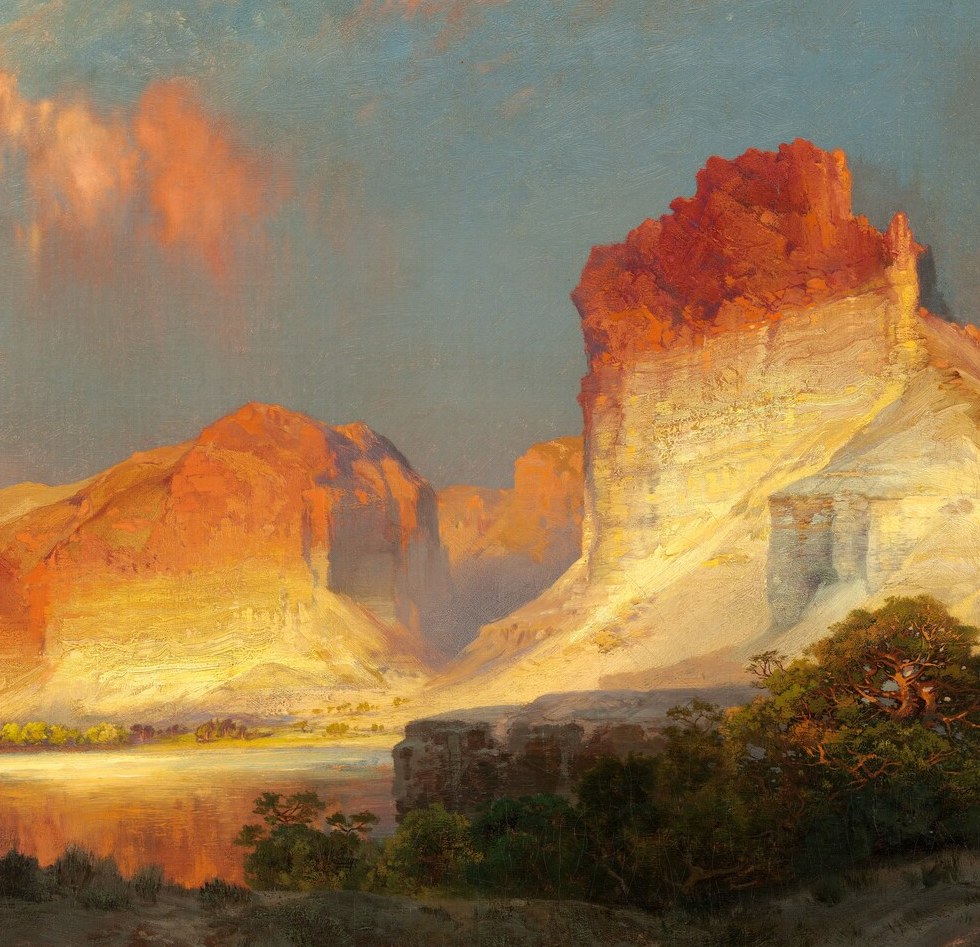
Thomas Moran painted 'Green River Cliffs, Wyoming' in 1881, after a decade of rail expeditions into the American West had made him one of the nation's most celebrated landscape painters. This work distills his lifelong project: to bring the luminous geology of the frontier back east as oil on canvas, and to make people feel the scale of a place they would likely never see.
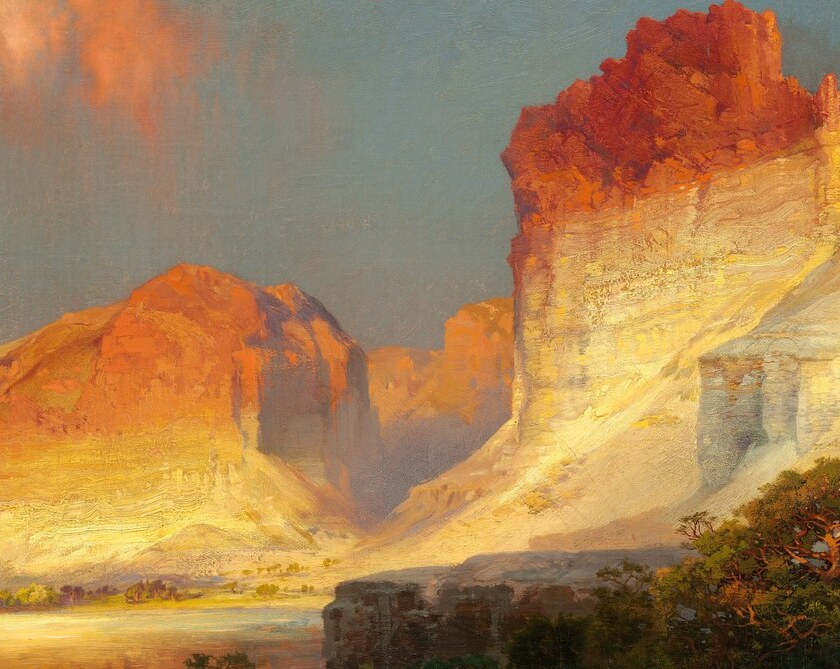
Look first at the central butte's sunlit face. Moran laid near-white impasto over a warm ochre ground, so the paint itself seems to emit light rather than just reflect it. Then let your eye drop to the Green River below, the reflection is a single, confident horizontal stroke that anchors the whole composition. The soft blue-gold band between the cliffs and the sky is wet-on-dry brushwork so delicate that the rock appears to dissolve into air.
Moran was the chief illustrator at Scribner's Monthly before his western travels, and he trained under the same Hudson River School tradition that produced Frederic Edwin Church. But where Church built cathedrals of light, Moran built geology. He studied the actual sandstone of Wyoming's Green River formation, and his aerial perspective, that haze band he prized, was both a painter's trick and an honest observation of the high-desert atmosphere.
The painting now belongs to a private collection. Look long enough, and you understand why Congress bought his earlier Yellowstone canvases: Moran gave America a visual argument for preserving the West.
Details

Transcript
A sandstone butte, hit by noon light. The paint itself glows. Moran built this with near-white impasto dragged over warm ochre. Now find the river. Its sheen is a single, unbroken stroke. That mirrored light pulls the sky's warmth down into the earth. The distant buttes dissolve into blue-gold haze. Wet brushwork, barely touched. Aerial perspective: Moran's most painterly zone. Pure atmosphere, no edges. The result: a landscape you walk into, not just look at.