清 柳堉 山水圖 卷|Traveling Amid Streams and Mountains by Liu Yu
This is Traveling Amid Streams and Mountains, an ink-on-paper handscroll painted by the Qing dynasty artist Liu Yu around 1680. The first thing to know is that its title is a clue. Most viewers scroll past the painting's human element entirely, but he is the reason the work exists.
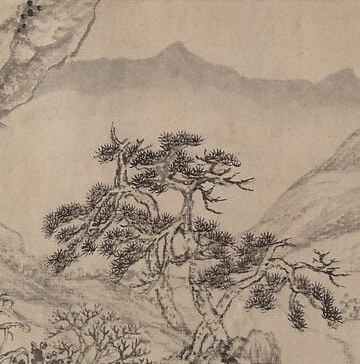
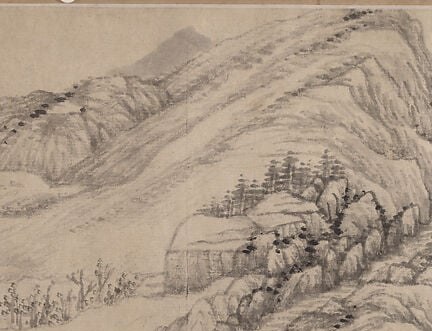
To find him, start at the foreground rocks on the lower left. Let your eye follow the narrow inlet of bare paper as it winds into the wide pale river. The broad expanse of unpainted paper is the painting's most powerful silence. Halfway up the shore, the path turns; a single tiny scholar stands there. His scale against the mountains is the whole argument of the piece. The dark pine cluster anchors the composition, but the figure gives it meaning.
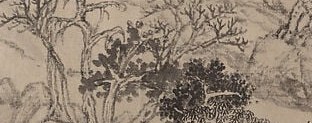
Liu Yu lived from 1620 until sometime after 1689, a span that carried him out of the Ming dynasty and into the Qing. Handscrolls like this one were not hung on walls. They were unrolled section by section, read right to left, so the journey unfolded in time as much as in space. The ink ranges from dense dry strokes on the rocky shore to wash so dilute that the distant peaks dissolve into mist. The empty sky above is not a void; in Chinese painting it is atmosphere, the air the mountains breathe, and a deliberate philosophical statement about presence and absence.
Next time you see a Chinese landscape, scan the paths. The painter is often hiding someone there.
Details

Transcript
First, look at the whole scene. A vast river valley, ink on paper. Towering pines and mist-shrouded mountains. But the title is Traveling Amid Streams and Mountains. Traveling. So where is the traveler? There. A single scholar on the shoreline path. He is nearly invisible. That is the point. The painter, Liu Yu, worked in 1680 as the Ming dynasty was a living memory.