Evening at Medfield, Massachusetts by George Inness
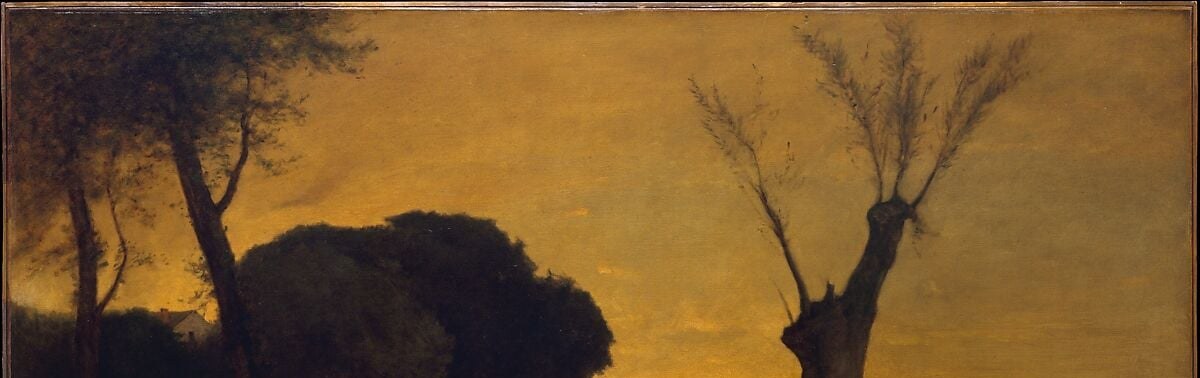
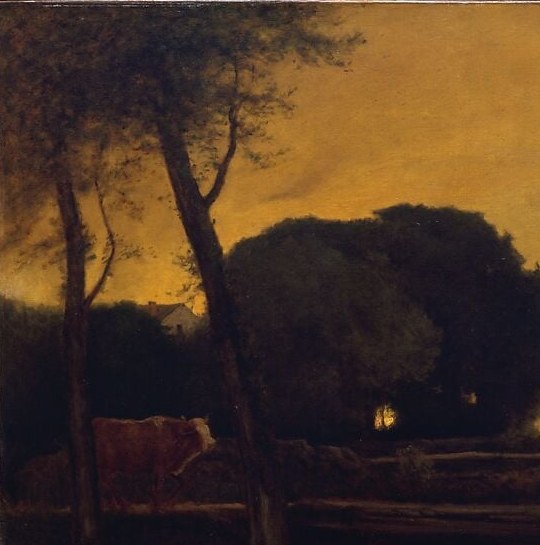
This is George Inness's Evening at Medfield, Massachusetts, painted in 1875 and now in the American Wing of the Metropolitan Museum of Art. At first glance it is a timeless pastoral scene: cattle settle into the darkening field as the sky burns down to amber. Inness was moving toward what would later be called Tonalism, building the entire emotional weight of a painting on atmosphere rather than sharp detail.
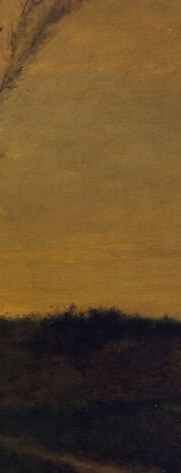
The painting rewards a closer look. Up in the left quadrant, bare branches dissolve into the sky so completely you cannot say where the tree ends and the air begins. That deliberate blur is Inness's signature move. And then there is the far right edge, where a thin vertical line rises against the trees. It is not another slender trunk. It is a telegraph pole.
1875 was exactly the moment telegraph wires spread through rural New England. Inness tucked the pole into the composition so quietly that most viewers scroll past it. A painting that feels like it could be 1775 turns out to be wired to the modern world. Inness was a follower of the theologian Emanuel Swedenborg, who taught that the divine could be glimpsed within the material world. Here, the eternal dusk and the brand-new wire share the same frame.
A landscape painter who spent his career chasing the spiritual in nature left us a document of a specific Thursday evening in 1875. The pole is still there if you look.
Details


Transcript
Dusk in Massachusetts. Cattle graze in the quiet. The whole painting is built on a fading sky. George Inness painted atmosphere, not objects. But now look at the far right edge. A telegraph pole. Almost invisible against the trees. 1875. The wires were spreading across New England. A quiet landscape holding the sound of the coming century.