The seizure of Abd-el-Kader's camp in 1843 by Horace Vernet
Horace Vernet's "The Seizure of Abd-el-Kader's Camp in 1843" depicts a pivotal moment in the French conquest of Algeria. This large-scale oil painting, completed in 1844, celebrates the decisive victory of the Duc d'Aumale's forces over Emir Abdelkader's 'smala' (mobile encampment) at Taguin on May 16, 1843.
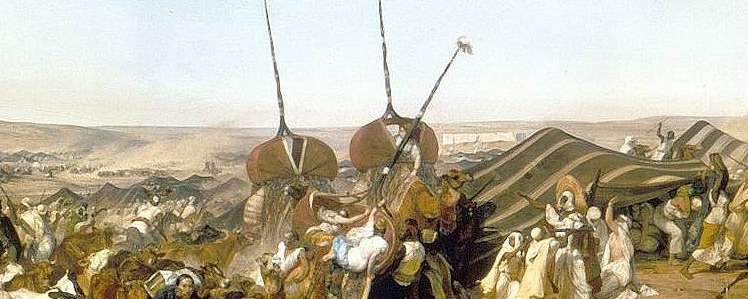
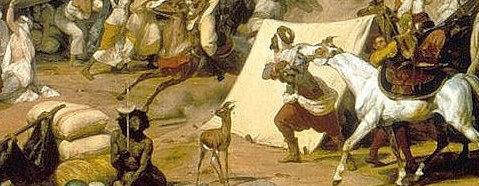
Look closely at the swirling chaos of the battle, with cavalry and infantry clashing amidst rising dust. The focal point is the captured 'smala' itself, seen in the large Arab tents, which served as the mobile capital of the Algerian resistance. Its seizure represented a significant strategic blow to Abdelkader's operations.
Commissioned by King Louis-Philippe I, whose son led the charge, the painting highlights the French military's success and the expansion of colonial power. It was exhibited at the prestigious Paris Salons of 1845 and 1855, becoming a visual record of a major military triumph. Today, it is housed in the Musée de l'histoire de France in the Palace of Versailles.
The painting's detailed realism, from uniforms to the horses, conveys the immediate intensity of this historical engagement.
Details

Transcript
This painting celebrates a French military victory in Algeria. It shows the 1843 capture of Emir Abdelkader's mobile camp, his 'smala'. The 'smala' was essentially the capital of the Algerian resistance. Its capture was a huge blow, a turning point in the war. The French flag here marks the triumph of colonial expansion. The King of France commissioned this painting soon after the battle.