Pompton Plains, New Jersey by Jasper Francis Cropsey
View the artwork: Pompton Plains, New Jersey →
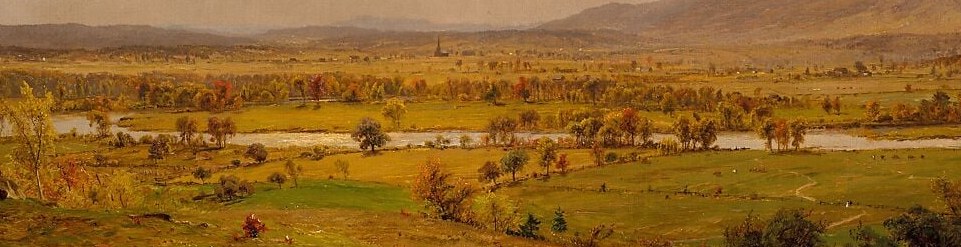
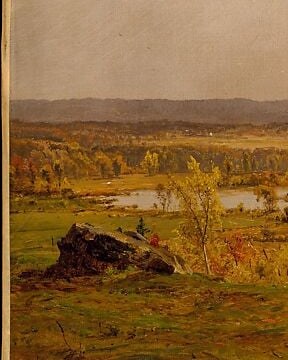
This is Pompton Plains, New Jersey, painted by Jasper Francis Cropsey in 1867. It is an image of deep, deliberate calm, made at a moment when the nation was still raw from the Civil War. Cropsey had just returned from six years in England and found himself painting the American countryside not as a dramatic wilderness, but as a place of light and settlement. The painting is now in the Metropolitan Museum of Art.
The entire composition is built on a horizon that stretches almost unbroken. At its dead center, a single church steeple rises through the haze. It is the only vertical accent for miles, and its place on the horizon is no accident. Cropsey saw the ordinary flatlands of northern New Jersey and framed them as a moral landscape, suffused with what he called providential calm.
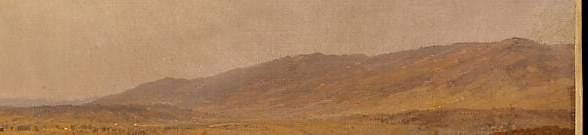
The painting is a study in luminism, a mode that moved away from the stormy theatricality of earlier Hudson River School work. Light appears to come from everywhere at once, dissolving the far hills into the sky. In that soft dissolution, Cropsey found a visual argument for reconciliation and order. The farm buildings nestled in the plain reinforce the point: this is not empty land, but a peopled, peaceful world.
Next time you see a flat horizon, slow down on the one thing that breaks it.
#arthistory #hudsonriverschool #jaspercropsey
Details


Transcript
An enormous sky. A flat, endless plain. New Jersey, 1867. The Civil War had just ended. Look at the horizon. One single, slender line rises. A church steeple. The only vertical thing for miles. Cropsey painted it as a sign of providential order. A quiet promise that the land itself could heal a nation.