View of Naples from San Martino by http://www.wikidata.org/.well-known/genid/e7be066e0715cd78e68727fd8cccef49
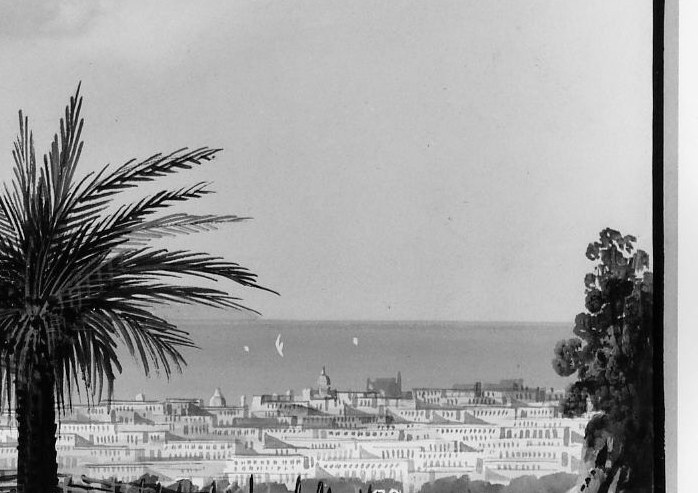
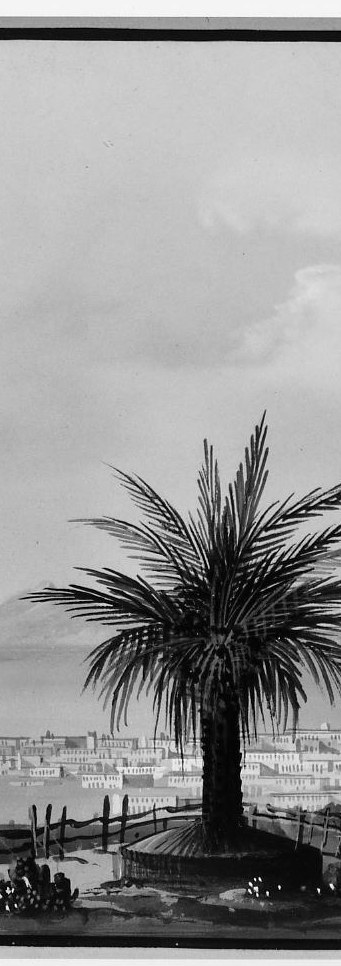
View of Naples from San Martino, painted around 1825 and attributed to the Neapolitan artist Consalvo Carelli, keeps an unexpected secret in plain sight. Its central vertical element is not a church tower, not a classical column, but a palm tree. The tree is real, it grew in the gardens of the Certosa di San Martino, a hilltop monastery that still overlooks the city, but its compositional job is pure invention. Carelli placed it dead center, running from the bottom edge to the top, to split the panorama into two realms: the dense civic fabric of Naples on one side, and the open sea on the other.
Look how the feathered crown of the palm breaks the horizon exactly where the city thins out. The trunk becomes a measuring stick. Without it, the view would still be beautiful, but it would feel wide and loose. With it, the painting gains a vertical spine, a controlled tension between the urban and the natural. The tiny sailboat out on the bay only feels tiny because your eye first anchored on the tree.
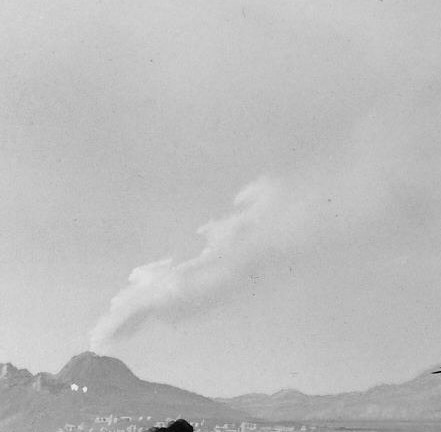
This is a pre-photographic record. In 1825, Naples had not yet been exhaustively documented by a camera; a painted panorama like this carried topographic value. Carelli gives you the city roof by roof, the smoke rising from Vesuvius on the left, and the low fence where sightseers stand in the foreground, positioning you, the viewer, as one of them. You are not floating above the scene. You are on the monastery terrace, looking past the famous palm.
Every painter of vast landscapes faces the same problem: how do you give it a skeleton? Carelli found his in a tree that was already there. The trick was noticing it.
Details


Transcript
You are standing at a monastery high above Naples. The bay, the city, the volcano, all of it spread before you. But the painter did something deliberate right in the foreground. A single palm tree shoots straight up through the picture. It divides the city from the sea like a mast. Palm trees are not native here. It was planted as a landmark. He used it to pin the whole vast view into one steady frame.