Camille Monet on a Garden Bench by Claude Monet
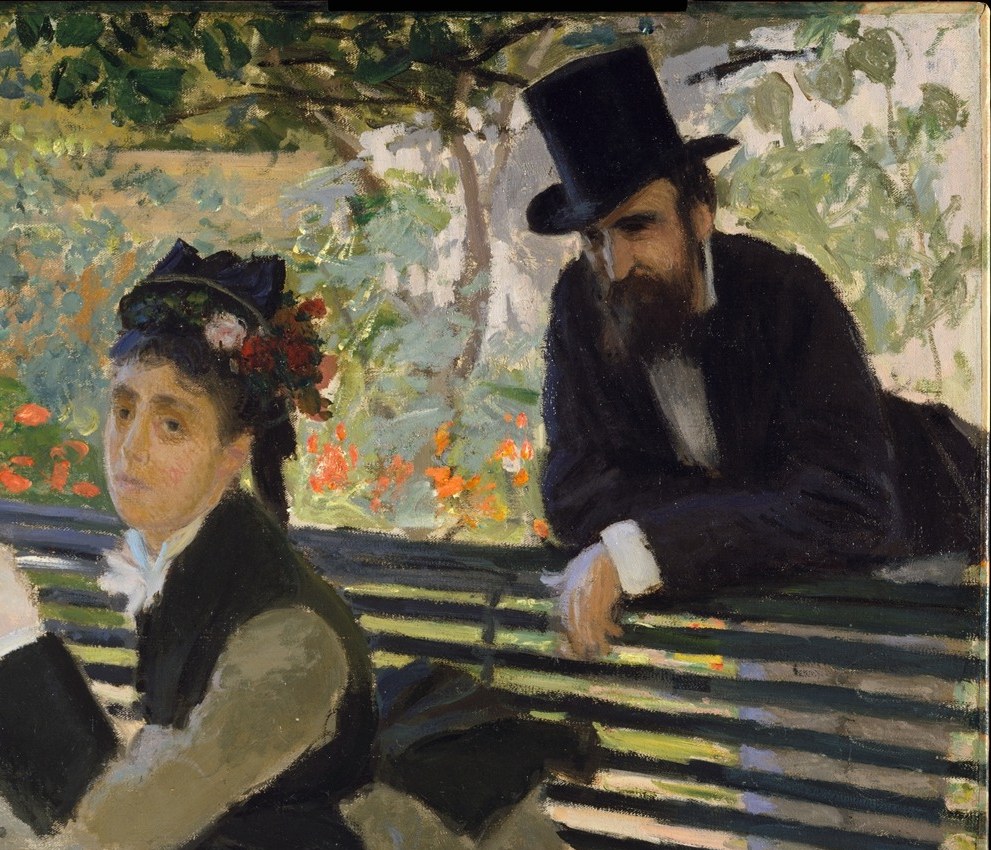
This is Claude Monet's "Camille Monet on a Garden Bench" (1873), at the Metropolitan Museum of Art. The married couple at the center are not the only story here.
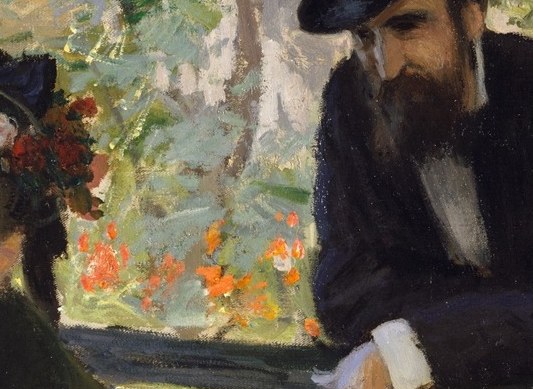
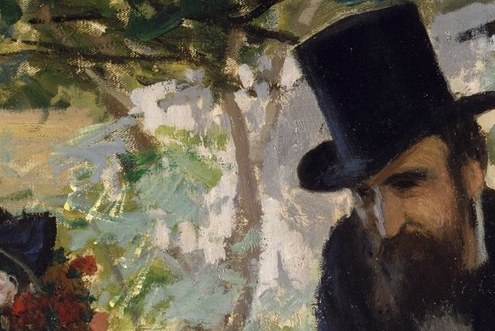
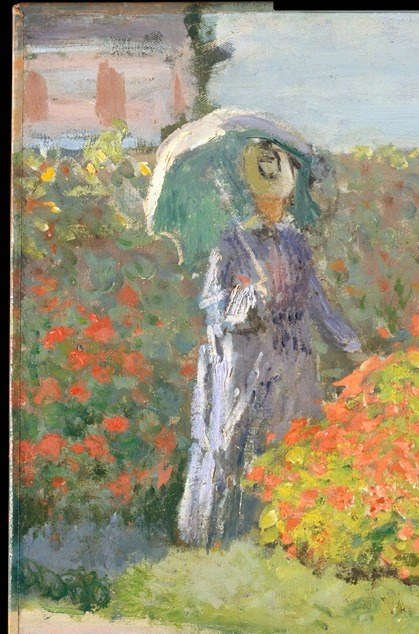
The painting presents Camille Monet, distracted, in a black dress, while a bearded man in a top hat looks away from her. But look deeper, past the blazing red flowers on the right: a ghostly third figure in a pale dress stands in the upper-left background. Her presence reframes the whole image as a social gathering, not a private moment.
Monet painted this while living on the estate of Ernest Hoschedé, a department-store magnate and his earliest patron. The bearded man is Hoschedé; the woman in the background is likely Hoschedé's wife, Alice. Six years after this sunlit scene, Hoschedé went bankrupt and fled to Belgium with his wife and Monet's family. Camille died of tuberculosis. Monet continued living with Alice. They eventually married.
This painting represents the gilded surface of a circle whose private lives were already entangling. The formal silences on the canvas, Camille's averted eyes, the man's turned back, read differently once you know who else is in the garden.
Details

Transcript
This is not a portrait of a happy couple. Camille Monet sits in a garden, but her gaze is elsewhere. The man behind her won't meet our eyes either. His identity was a scandal Monet kept quiet for decades. He was Ernest Hoschedé, a department-store magnate and Monet's patron. Monet painted this in 1873, while living on Hoschedé's estate. Two women hold the center: Camille, and another woman at the upper left. That may be Alice Hoschedé. Six years later, Ernest was bankrupt, and Monet moved in with Alice.