Pushing for Rail by Thomas Eakins
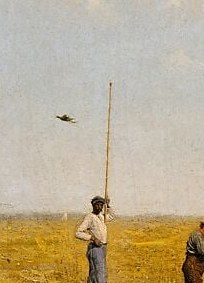
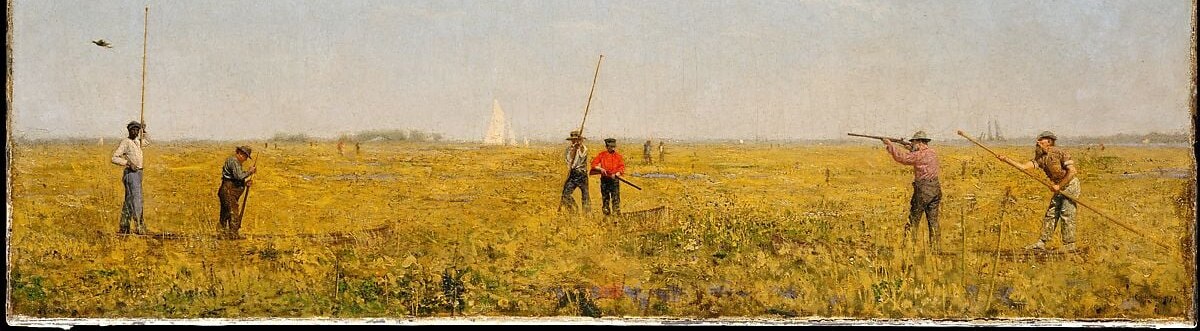
Thomas Eakins painted Pushing for Rail in 1874, and most people scrolling past it see only a golden marsh under a pale sky. But scan the upper left corner and the whole picture snaps into focus: a handful of small dark birds are cutting across the clouds, and every man in the frame is watching them.
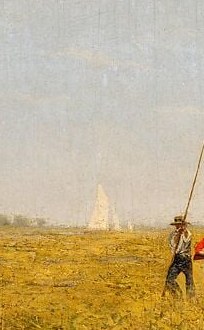
The central figure with the tall pole is the pusher, the one doing the work the title describes. His job was to push through the reed beds of the Delaware River marshes to flush rail birds into the open, where the other hunters could take their shot. Eakins spaced those hunters across the canvas like notes on a staff, using their vertical poles and gun barrels to punctuate the long horizontal sweep of the grass.
Eakins was Philadelphia through and through. He painted the people of his city, rowers, surgeons, hunters, from direct observation, often taking friends and acquaintances out into the field as models. For this painting he surveyed the marsh site himself, and the tonal range of the autumn grass is the main event: golds, ochres, and pale straw that he matched against a diffuse midday sky.
It is a painting that rewards patience. Find the birds, and you find the story. Notice the horizon, nearly featureless, dead flat, and you feel how far sound carries across that open ground.
Details

Transcript
At a glance, it feels like an empty autumn marsh. A few men spaced out across the grass. Poles and guns. But look closely above the leftmost hunter. Three tiny birds are breaking across the sky. Eakins painted this from life in the Delaware marshes. The man in the center is the pusher, he poles through reeds to flush the rails. Everyone around him is poised for those birds.