Flower Beds in Holland by Gogh, Vincent van
View the artwork: Flower Beds in Holland →
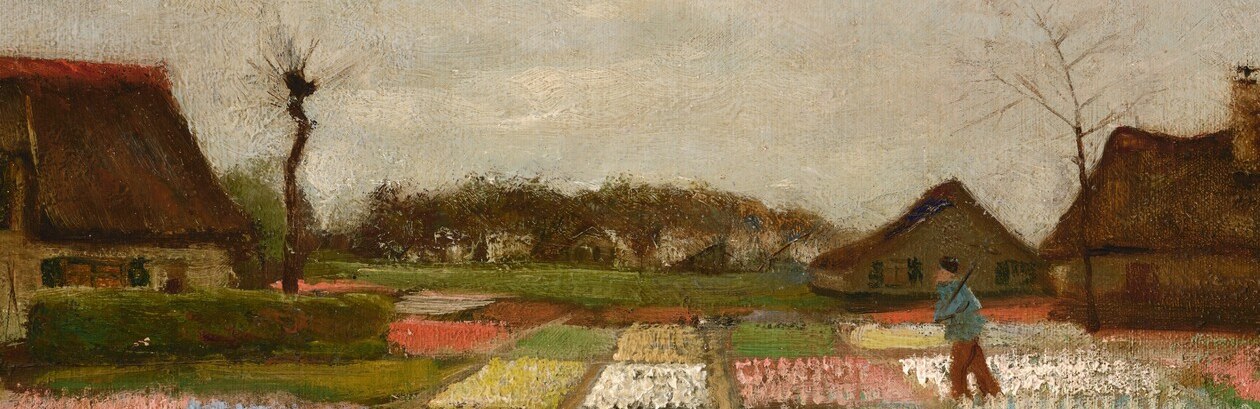
This is Vincent van Gogh's first garden painting, Flower Beds in Holland, made around 1883 and now in the National Gallery of Art in Washington. The subject is not a decorative garden but a commercial bulb farm, and the painting acts as a kind of visual catalogue of early-spring hyacinth varieties.
Look at the strips. Each one is a distinct colour, blue, pink, red, white, yellow, corresponding to a different commercial variety grown for the Amsterdam flower market. The flowers are still low, the soil freshly turned, and a bare tree behind the farmhouses anchors the season precisely in March or April. Van Gogh's low vantage point flattens the field into a near-abstract study of perspective and parallel recession.
Painted in The Hague during his second year as an artist, Van Gogh likely left the work with his family when he moved on. It was later stored by a carpenter, Adrianus Schrauwen, who in 1902 sold it as worthless 'rubbish' to a dealer. It was exhibited that year under the wrong title, Tulpenland, 'Tulip Country', even though every flower here is a hyacinth. The painting passed through several hands before Paul Mellon acquired it in 1955 and donated it to the nation.
A painting that was once discarded as trash now hangs in one of the world's great museums. What does that say about how we learn to see?
#arthistory #vincentvangogh #postimpressionism
Details

Transcript
A flat field of colour, row after row. Not a wild meadow. A working bulb farm. Each rectangle is a different commercial variety. Blue hyacinths, the most intense colour in the scene. Warm pink and red command the highest price. The bare tree tells you it is early spring. In 1902, a carpenter sold this painting as rubbish. Van Gogh was kneeling in the mud to paint it.