Artwork
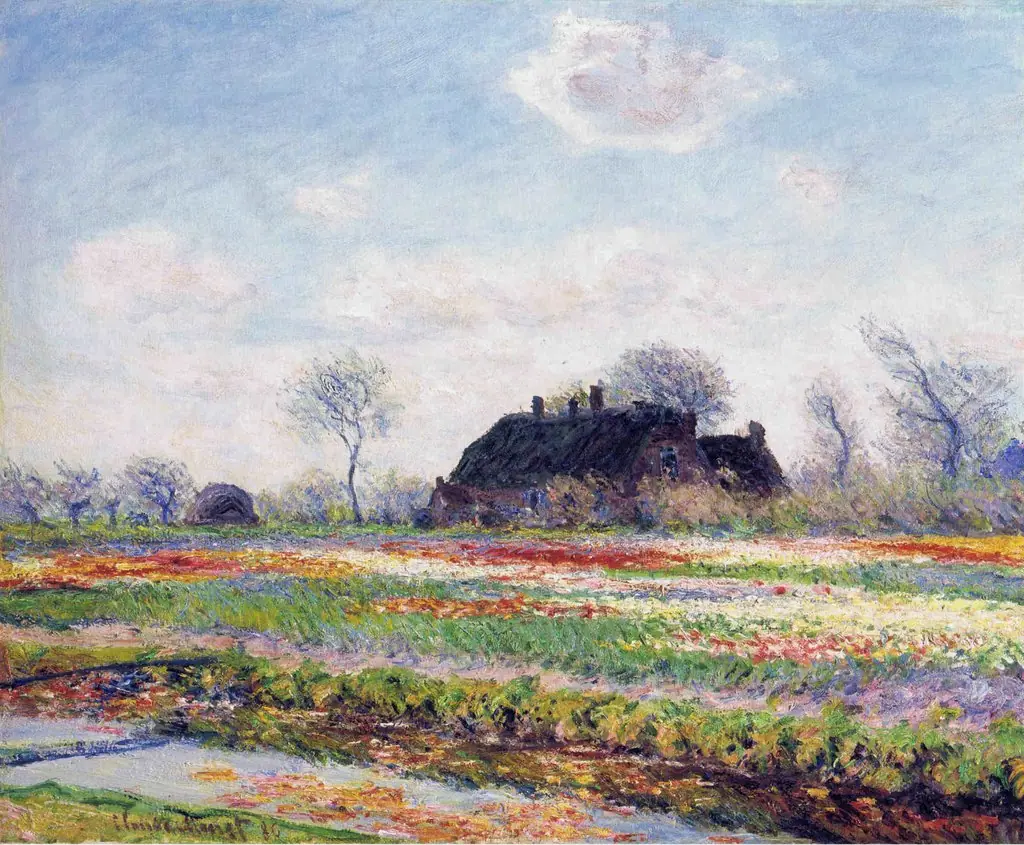
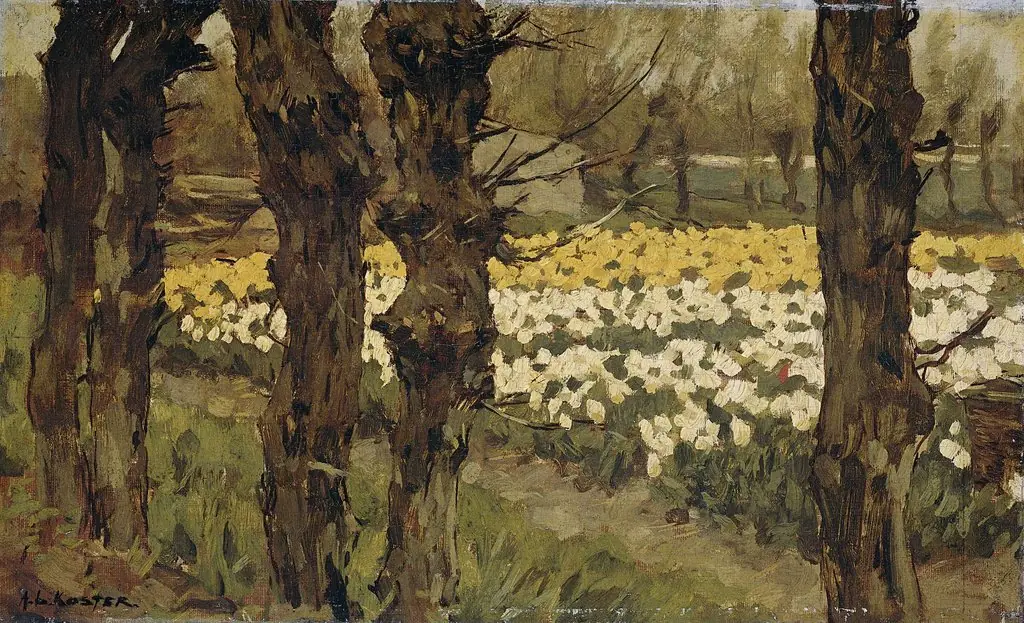
Flower Beds in Holland
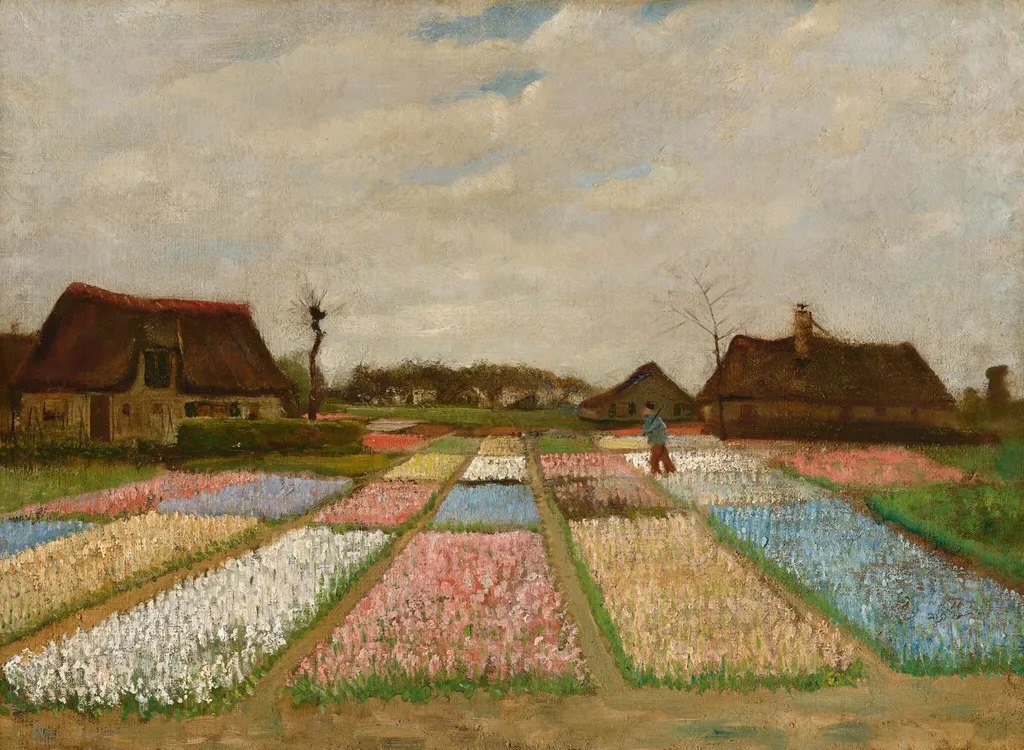
Flower Beds in Holland is an oil painting by the Impressionist artist Vincent van Gogh. It dates from 1883 and is held in the collection of the National Gallery of Art.
About this work
Subject & Meaning
Iconographically the work combines naturalistic detail with a symbolic representation of agricultural abundance and the simple, orderly life of the Netherlands.
The painting depicts a rectangular field of hyacinths in blue, yellow, pink and red, bordered by a modest house, leafless trees and a thatched cottage, all rendered from a low vantage point that creates a panoramic view of the Dutch spring landscape. Executed in oil on canvas mounted on wood in early 1883 while Van Gogh was in The Hague, it is regarded as his first garden painting and marks his exploration of perspective in a rural setting. The orderly arrangement of coloured flower beds, together with the farmhouse, conveys the fertility and seasonal renewal associated with the Dutch countryside.
Iconographically the work combines naturalistic detail with a symbolic representation of agricultural abundance and the simple, orderly life of the Netherlands.
Technique & Style
Flower Beds in Holland is an oil painting on canvas mounted on wood executed in early 1883 in The Hague. Its modest dimensions (48.9 × 66 cm) and rigid support suggest a panel-like handling suited to early plein-air sketches. The paint is applied in thin, even layers to preserve the weave of the coarse canvas, a method consistent with Van Gogh’s experimental practice at the time.
The composition is organized into broad, horizontal color planes, rectangular beds of blue, yellow, pink and red hyacinths, rendered with flat, high-key hues that prefigure his later bold colorism. A low vantage point flattens recession, while the regular geometry of plots and scattered leafless trees heightens the rhythmic, pattern-driven structure. The overall condition is stable with only minor craquelure, indicating careful storage and limited exposure to environmental fluctuation.
History & Provenance
Created in early 1883 during Van Gogh's second year in The Hague, this oil on canvas mounted on wood was likely abandoned in Nuenen in late 1885. It subsequently moved to Breda in 1886 with the artist's mother and sister, where it was stored by carpenter Adrianus Schrauwen. In 1902, Schrauwen sold the work, described as worthless rubbish, to furniture dealer J.C. Couvreur, who passed it to Kees Mouwen and Willem van Bakel.
Consigned to Kunsthandel Oldenzeel in Rotterdam in 1904, it was acquired by Jan Smit in 1905. Smit sold it at auction in 1919 to his grandson, John Enthoven. Following a 1954 tenure with Frank Perls Gallery and M. Knoedler & Co., Paul Mellon purchased the painting in January 1955, donating it to the National Gallery of Art in 1983.
Since 1983 the painting has been held by the National Gallery of Art, Washington, D.C., as accession no. 1983.1.16. It was donated by Paul Mellon, who acquired it in January 1955 from M. Knoedler & Co., New York. Earlier, it passed through John Enthoven (by 1954), his grandfather Jan Smit (purchased 1905; sold 1919), and dealers including Kunsthandel Oldenzeel (Rotterdam, exhibited 1904).
Context
Flower Beds in Holland is regarded as Vincent van Gogh’s first garden painting, executed in oil on canvas mounted on wood during his second year in The Hague (1883). The work depicts rectangular plots of blue, yellow, pink and red hyacinths cultivated by a Dutch bulb merchant, rendered from a low vantage point that yields a panoramic view of the colorful spring field with thatched cottages and leafless trees in the background. Its regular composition allowed Van Gogh to explore perspective, a concern that would recur throughout his oeuvre.
After being stored with family works in Nuenen and Breda, the painting was exhibited in 1902 at Rotterdam’s Kunstzalon Oldenzeel under the title Tulpenland, marking its earliest public exposure. It subsequently passed through several dealers before being acquired by Paul Mellon in 1955 and donated to the National Gallery of Art in 1983. Scholarship notes its inclusion in Jacob Baart de la Faille’s catalogue raisonné, situating it within Van Gogh’s early Hague period and highlighting its role as a precursor to his later floral studies and his developing interest in color and spatial organization.
Legacy
Flower Beds in Holland has been recognized as a foundational garden painting in Van Gogh’s oeuvre, noted for marking his first oil depiction of a cultivated garden and his engagement with structured perspective. The work’s later reputation grew through inclusion in major exhibitions such as the 1936 Yale Alumni show and later presentations including Monet in Holland and Around Impressionism at the National Gallery of Art, Washington, where it has been a centerpiece since its 1983 donation by Paul Mellon. Though initially undervalued when sold as part of a group of early works in 1902, its status has risen as a key example of Van Gogh’s early Hague School period, reflecting his evolving technical and thematic concerns before the more celebrated later works.
Overview
Vincent van Gogh painted Flower Beds in Holland in early 1883, marking his initial foray into garden subjects rendered in oil. This work, executed on canvas mounted on wood, captures a vibrant agricultural landscape. It was eventually donated to the National Gallery of Art in Washington DC in 1983, where it remains part of the collection.
Own this work as a print
Artist & collection
Artist
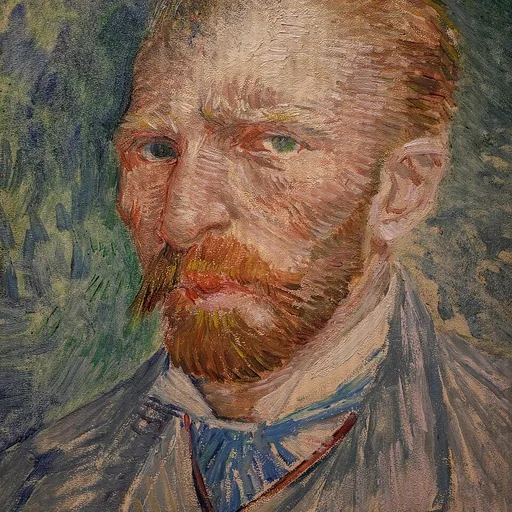
Vincent Willem van Gogh was a Dutch Post-Impressionist painter who is among the most famous and influential figures in the history of Western art.