元/明 趙原 倣燕文貴范寬山水圖 元/明 沈巽竹石 合卷|Landscape by Zhao Yuan
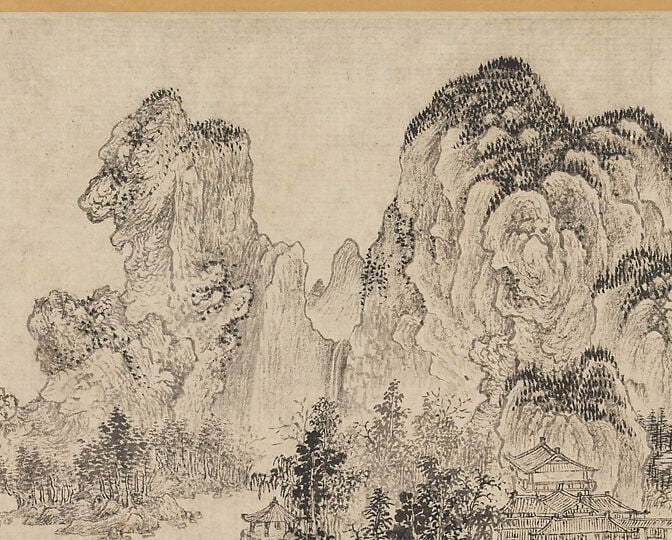
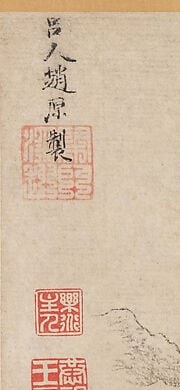
This is 'Landscape,' a handscroll painted in ink on paper by the Chinese artist Zhao Yuan in 1383. Its composition of jagged peaks, drifting mist, and tiny travelers is a direct conversation with the past. In the upper left, an inscription names the two earlier masters Zhao Yuan is consciously imitating: Yan Wengui and the great Song dynasty painter Fan Kuan.
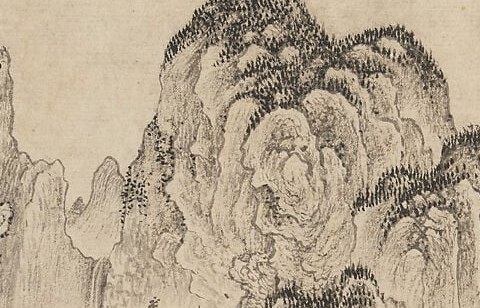
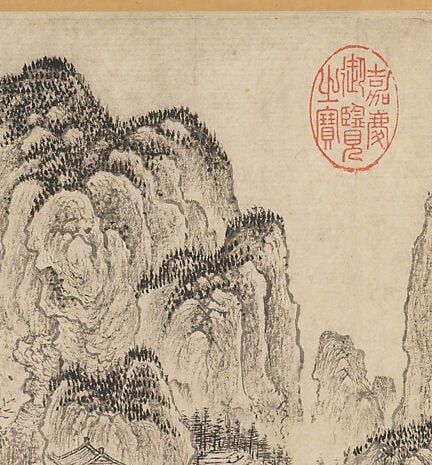
Look closely at the main cliff face and you will see the painting's true subject, which is brushwork itself. The mountain is not a solid silhouette but a dense field of parallel curved strokes called hemp-fiber texturing. Each mark is distinct, laid down with diluted ink, and together they create a powerful illusion of geological weight. The white mist band slicing horizontally through the peaks is unpainted paper, doing the vital work of atmosphere.
Zhao Yuan painted this nearly 300 years after Fan Kuan's death. In the Chinese literati tradition, copying a master was not derivative, it was a form of study and a way of extending an artistic lineage. By inhabiting an older painter's technique, stroke by stroke, Zhao Yuan inserted himself into a continuous chain of inheritance. The landscape becomes a living record of memory passed through the hand.
The mountain is made of ink, water, and time. What tradition are you continuing without even noticing?
Details
Transcript
It looks like a solid mountain. Now look closer at the cliff face. Hundreds of individual brushstrokes. This is hemp-fiber texturing. The painter learned it from a master who died 300 years earlier. Fan Kuan built mountains exactly this way in the year 1000. Zhao Yuan copied him stroke for stroke, and in doing so, kept the conversation alive. The mountain is made of ink, water, and three centuries of memory.