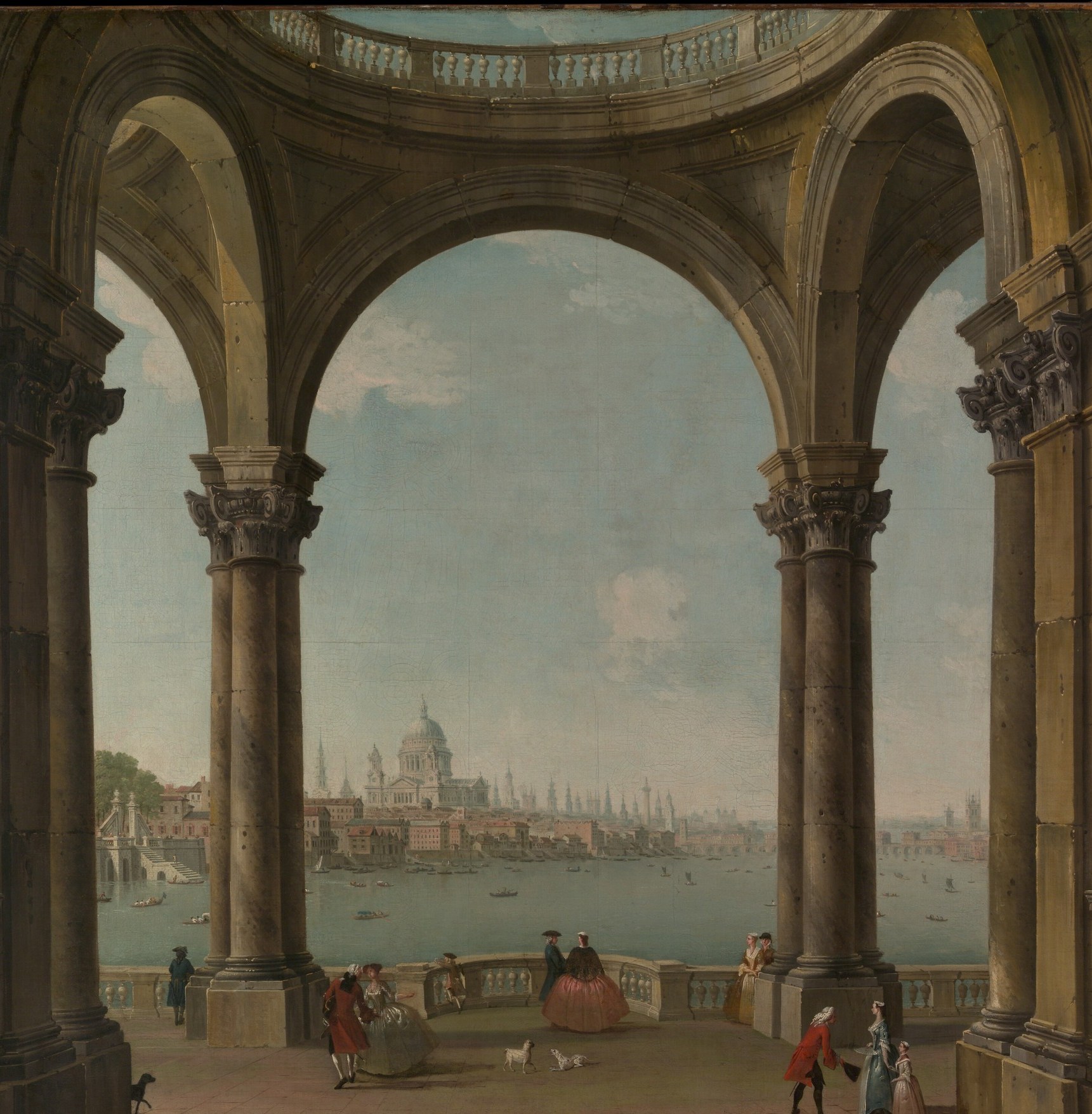
Capriccio with St. Paul's and Old London Bridge by Antonio Joli
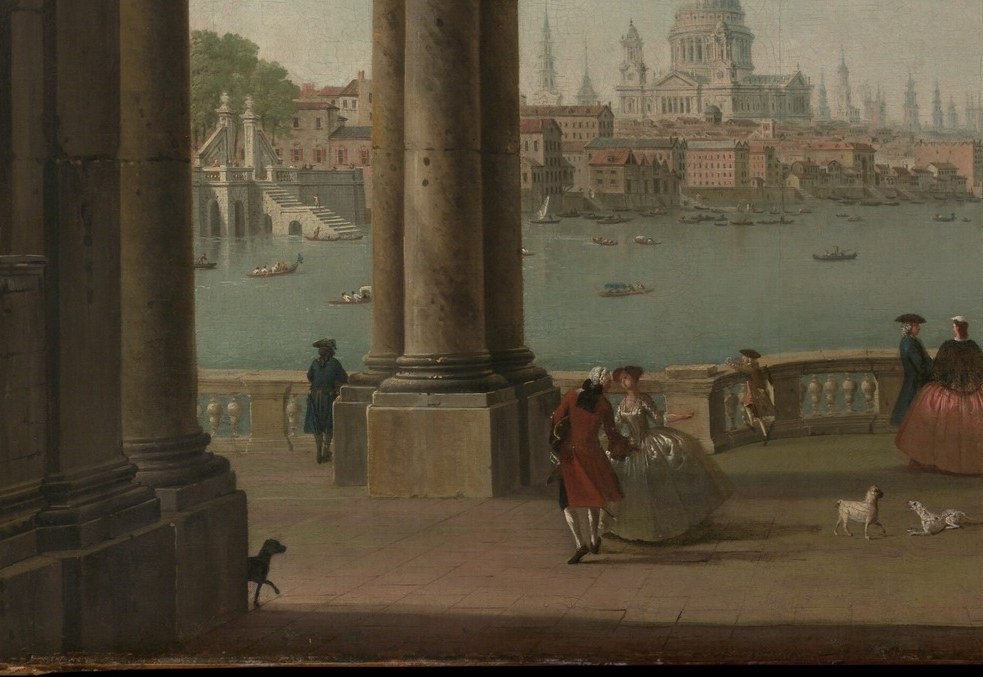
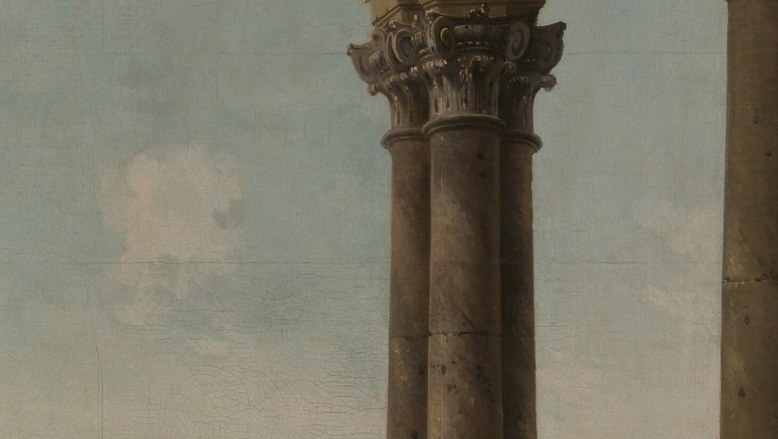
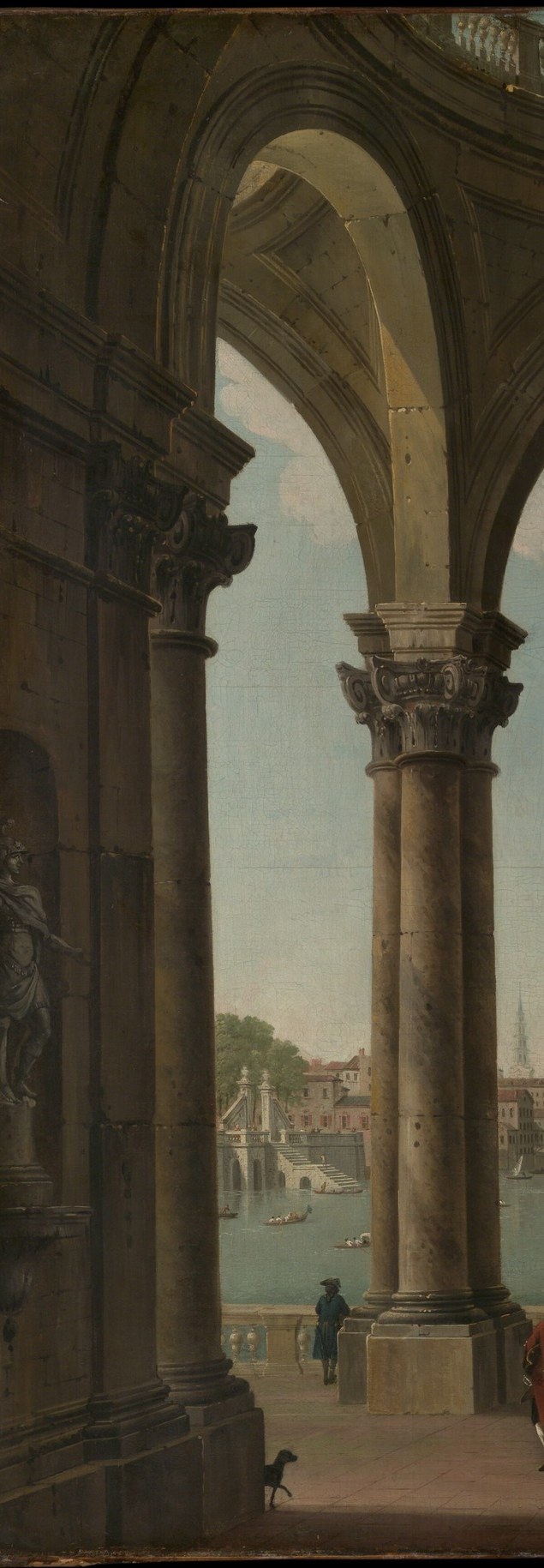
Antonio Joli’s “Capriccio with St. Paul’s and Old London Bridge” (1748) is a fiction. The grand stone balcony, the heavy Roman columns, the polite figures in conversation, none of it existed on the Thames bank. Joli built this viewpoint in his head, assembling a London view that is part theater set and part travel document.
Look through the arch. St. Paul’s dome rises exactly where it should, the one fixed point of topographic truth in the painting. Below it, Old London Bridge spans the river packed with the houses and shops it carried for centuries. Joli gives us a rare glimpse of the medieval bridge less than a century before it was demolished. The shipping on the Thames places us in a working commercial port; the spire-filled skyline behind it is a record of Wren’s rebuilt City churches, many now lost.
Joli was a Venetian scene painter who moved through Europe painting capricci, idealized architectural fantasies, for Grand Tour travelers who wanted souvenirs of the cities they visited. He arrived in London in 1744 and worked as a theater designer at the King’s Theatre, Haymarket. This painting dates from his final London year, 1748, just before he left for Madrid. The foreground figures in their 1740s dress are stock types, staffage he placed to give human scale to the enormous invented architecture. The real subject is the contrast: a Roman arcade that never was, framing an English skyline that was already vanishing.
The painting hangs in a private collection. Its value lies partly in its documentary power, a London that no longer exists, seen through an arch that never did.
Details
Transcript
This London view cost nothing to build. It is an entirely invented balcony. These 1748 fashions? The painter’s Italian staffage, reused. St. Paul’s dome is real, the one topographic anchor. And Old London Bridge, packed with houses, still stands. It was demolished in 1831. Joli painted it the year before he left London.