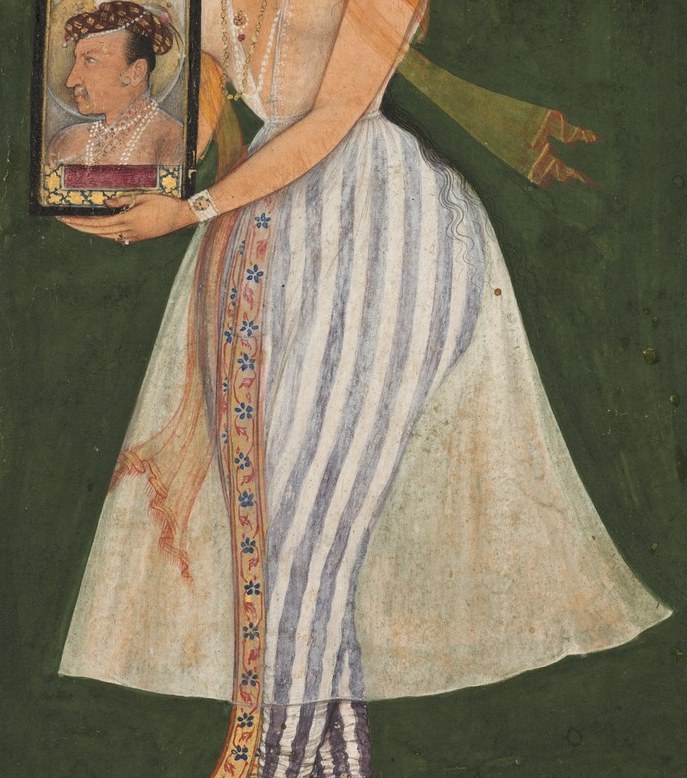
Nur Jahan holding a portrait of Emperor Jahangir by Bishandas (Indian)
This striking portrait, "Nur Jahan holding a portrait of Emperor Jahangir" by Bishandas, painted in 1627, offers a glimpse into the life of one of history's most powerful women. Housed at The Cleveland Museum of Art, it captures Nur Jahan at a pivotal moment.
Notice her bare feet, often interpreted as a sign of humility or respect, contrasting sharply with the intricate embroidery of her gown and elegant beaded necklace, which speak volumes of her immense wealth and status. She holds a miniature portrait of her husband, Emperor Jahangir, a crucial symbol of her connection to power.
Historically, Nur Jahan was the only woman to effectively rule the Mughal empire. By the time this painting was created, Emperor Jahangir was in declining health, and Nur Jahan governed in his name, making this portrait a subtle yet potent declaration of her authority and influence. Her contemplative gaze adds to the painting's mystery and depth.
What do you think her expression reveals about her thoughts at this significant time?
Details
Transcript
Nur Jahan, the only woman to rule the Mughal empire. She stands barefoot, a sign of respect, even humility. Yet her gown's embroidery and necklace signal immense wealth. She holds Emperor Jahangir's portrait, her husband, her power. When this was painted, he was dying. She ruled in his name. Her gaze downwards suggests reverence, or perhaps deep thought.