Evening at the Lock, Napanoch, New York by Theodore Robinson
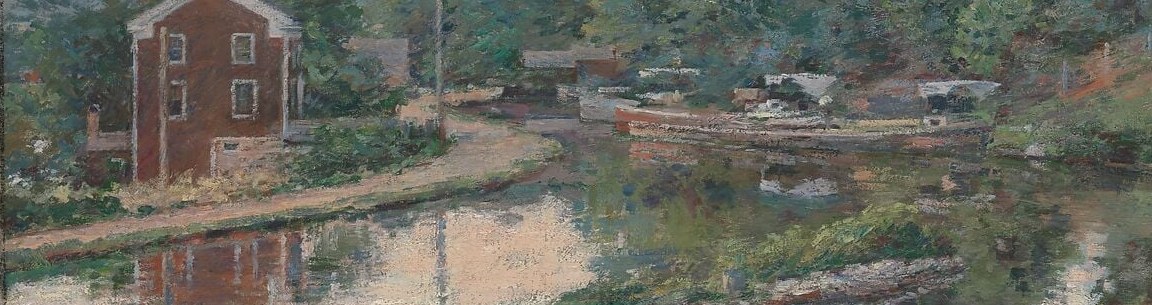
This is Theodore Robinson’s “Evening at the Lock, Napanoch, New York,” painted in 1893. Robinson was one of the first Americans to take Impressionism seriously, and he didn’t just imitate it. He brought its attention to fleeting light back from Giverny and pointed it at a working canal in rural New York.
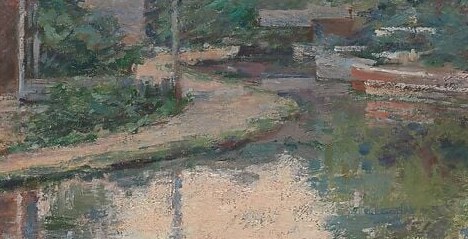
The painting is a study of the last light of day. A silver-gold patch on the water catches the sky’s last warmth, while the red brick lock-house on the left bank dissolves into a wavering reflection. The brushwork is loose and fast, especially in the dark tree reflections along the water’s edge, where the marks become almost abstract.
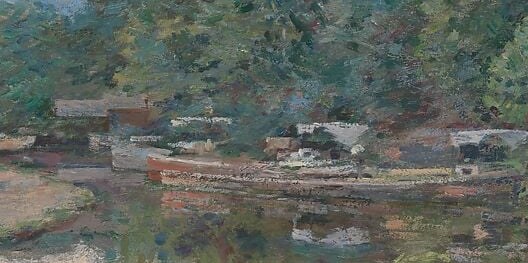
Robinson spent this period in Napanoch, a small town on the Delaware and Hudson Canal. He took the same technique he had used to paint French poplars and cathedrals and trained it on the American infrastructure of commerce. The barge moored at the dock is not a decorative boat; it is a working vessel, and the lock itself, though fading into the dusk, is a functional piece of engineering.
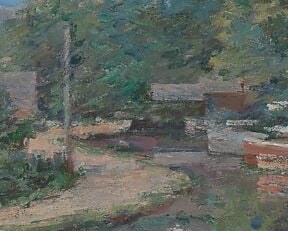
The title tells you where to look, but the shadow makes you work for it. The wooden lock gate timbers are still there, half-swallowed by the evening. Robinson painted a moment when the day’s labor recedes into stillness, leaving only light on the water.
Details
Transcript
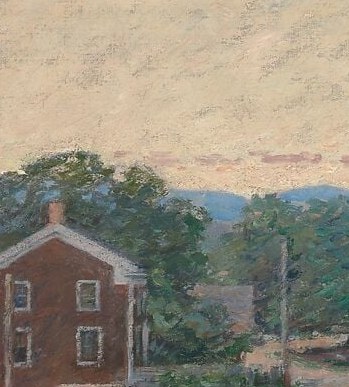
Dusk, 1893. A canal in the Appalachian foothills. Theodore Robinson painted the fading light with small, fast strokes. He learned this in France, beside Monet. But this is not France. It is Napanoch, New York. The title points to the lock, hidden in shadow on the left. Look closer: the old wooden gate timbers are still visible. Robinson gave an American working canal the same reverence as a French haystack.