View of La Crescenza by Claude Lorrain
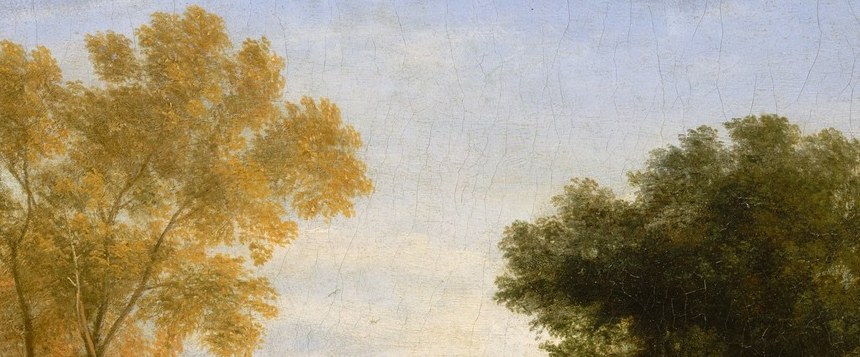
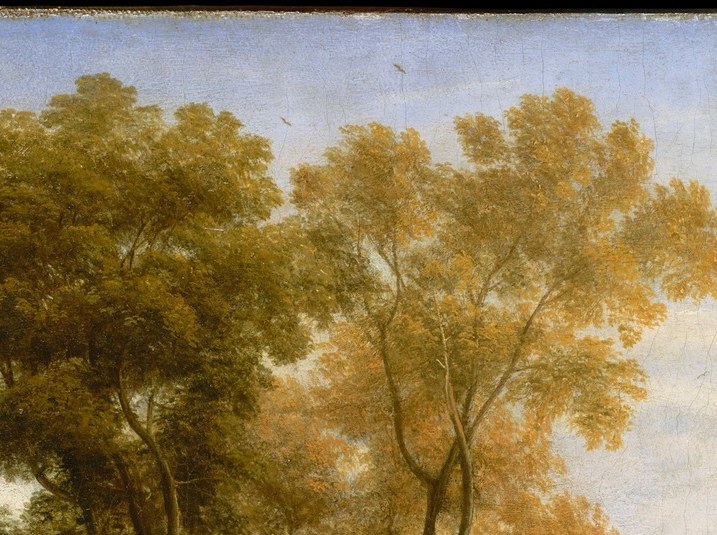
This is Claude Lorrain's View of La Crescenza, painted around 1650 and now at The Metropolitan Museum of Art. The painting contains no visible sun, yet the entire landscape is organized around light spilling from a single hidden point behind the treeline. Lorrain was the first major painter to make the unseen sun the emotional engine of a picture. Before him, landscape painters showed the sun directly when they wanted radiance. He realized that hiding it made the light feel sacred rather than literal, and the technique rippled through art history: Turner worshipped him for it, and the Hudson River School painters studied these gradients as a how-to manual.
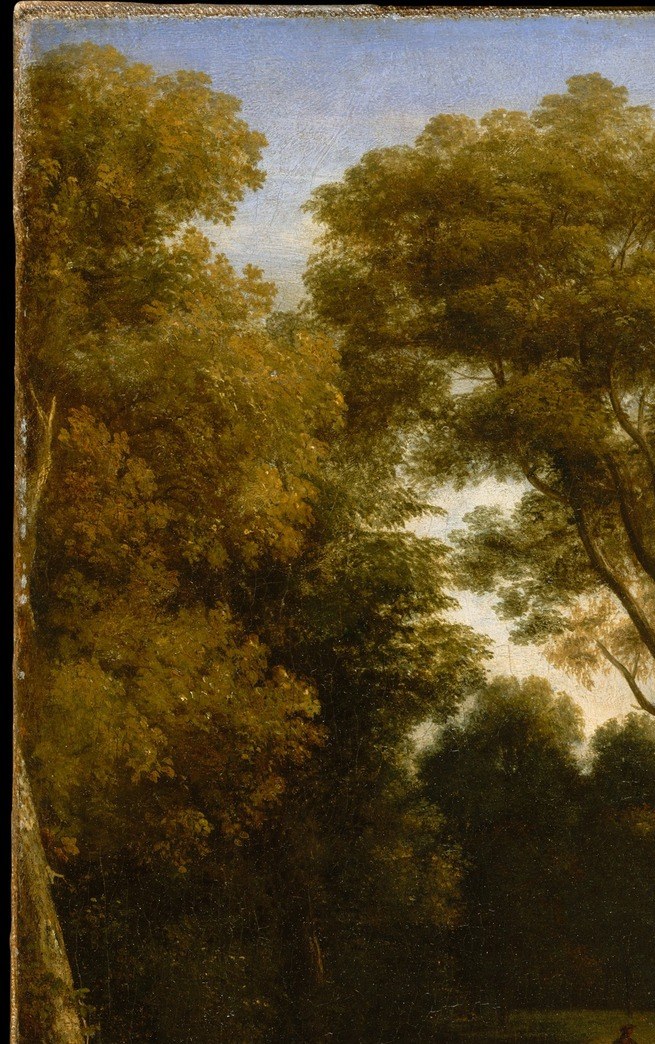
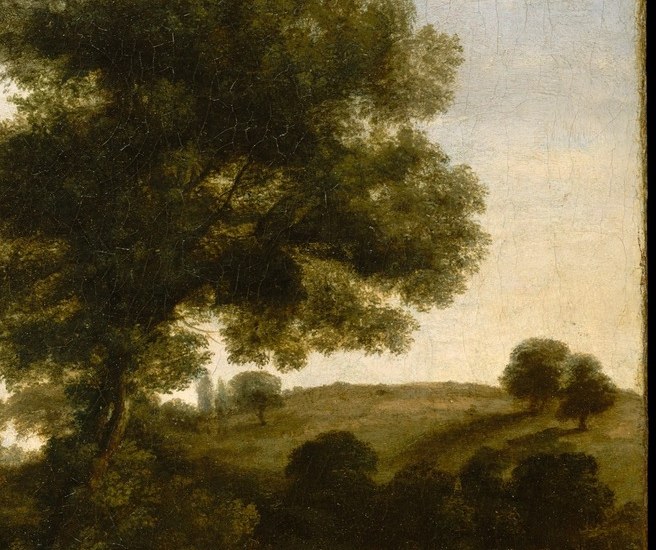
Look at how the picture is built in layers of dark to light. The deep black tree mass on the left is not there because the view required it, Lorrain placed it deliberately as a repoussoir, a dark coulisse that punches your eye toward the luminous distance. Then the hills step back in four distinct planes: warm russet earth in the foreground, cool green mid-distance, blue-green far hills, and finally the pale gold haze at the horizon. Each band shifts in hue and value with almost mathematical control. This is aerial perspective turned into an exact science, all before anybody had a word for atmospheric optics.
Claude was born around 1600 in the Duchy of Lorraine and spent virtually his entire working life in Italy. By the late 1630s he was the most sought-after landscape painter in Rome, commanding large fees and working slowly. He kept a record book called the Liber Veritatis, a drawn catalogue of every painting he ever sold, to protect against forgeries, which is now a primary source for art historians. View of La Crescenza takes its name from a real Roman campagna estate, but Lorrain has idealized it into a vision of Arcadia where human life, represented by the tiny shepherds and cattle in the foreground, is a footnote inside a vast and ordered eternity.
Next time you see a glowing horizon in a painting or a photograph, ask yourself where the light is coming from. Lorrain taught the Western eye to feel a sun it cannot see.
Details

Transcript
You are looking at a landscape with no sun in it. Yet the whole sky glows from one hidden point. Before Lorrain, painters showed the sun. He hid it. Look at the darkness he built to make that light work. A black wing on the left. It pushes your eye into the distance. Now the hills. See the colors shift as they recede. Warm brown. Cool green. Pale blue. Four precise steps into haze. Turner copied this trick. The Hudson River School copied Turner.