Untitled by Kawanabe Kyōsai 河鍋暁斎
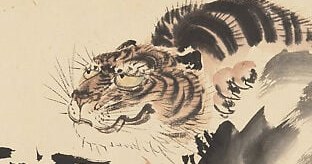
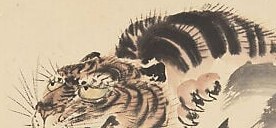
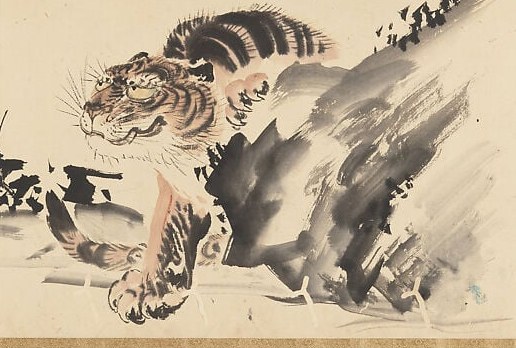
Kawanabe Kyōsai painted this tiger on a handscroll around 1868, using only ink, water, and paper. The scroll is now in the collection of the British Museum.
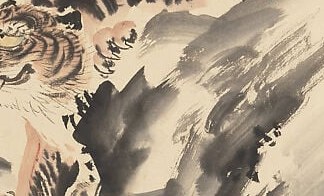
Look closely at the dark stripes on the tiger's flank. Each one is a single stroke of a loaded brush. The center of the stroke is wet and dark; the edges are dry and feathered where the bristles dragged across the paper. The entire illusion of fur, muscle, and volume happens in that one motion. No overpainting, no second pass.
This technique is called tsuketate, loading the brush with ink and water so that tone shifts within a single stroke. Kyōsai was a master of it. Art historian Timothy Clark called him 'an individualist and an independent, perhaps the last virtuoso in traditional Japanese painting.' He worked during the final years of the Edo period and the opening of Japan to the West, a time when the old training systems were collapsing.
What you're seeing is not just a picture of a tiger. It's a physical record of a hand moving at the speed of thought.
Details
Transcript
A tiger, drawn at the speed of attack. Kyōsai painted this in the late 1860s, on a handscroll. But see how he builds a stripe. One loaded brushstroke. Wet in the center. Dry, feathered edges. No correction. The ink pools into shadow while the brush is still moving. He was called the last virtuoso of traditional Japanese painting.