"King Lear," Act I, Scene I by Edwin Austin Abbey
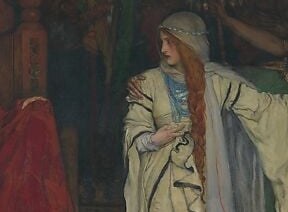
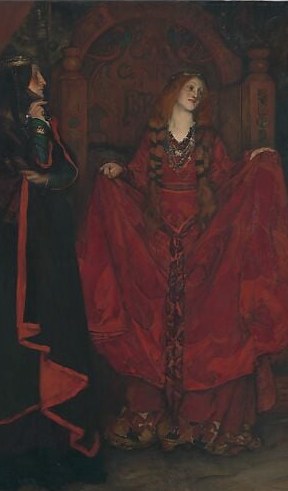
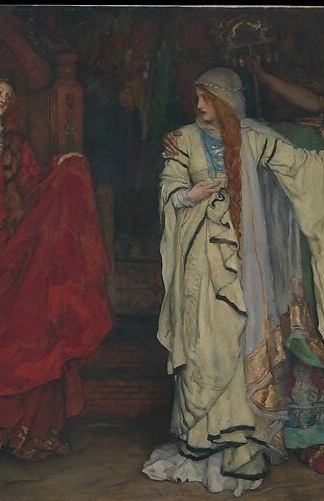
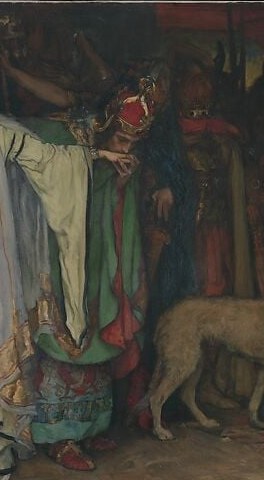
Edwin Austin Abbey painted this moment from Shakespeare's "King Lear" in 1898. It shows Act I, Scene I: the king divides his realm between his daughters, setting the tragedy in motion. The canvas lives at the Metropolitan Museum of Art.
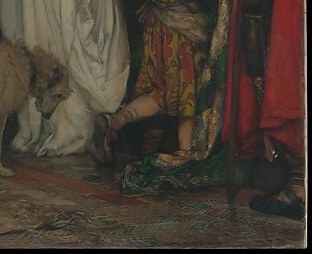
The composition sweeps your eye from Lear's raised hands, down to the ambitious daughter in crimson, and then left across the dark court. But the real reward sits at the far right edge, where most viewers stop looking. Abbey placed an enormous Irish wolfhound there, calm and watchful, its pale coat easy to miss against the gloom.
Abbey was an American illustrator who became one of the great Shakespearean painters of his era. He filled the scene with details a casual glance passes over. The tight cluster of courtiers in shadow on the left, the cold architecture pressing down, and that one loyal hound nobody is paying attention to all underline the isolation of the king at the center.
The dog does not move, does not plead. It just stays. While humans scheme, the animal witnesses. What does it say that the most faithful creature in the room is the one carved off into the margin?
Details
Transcript
A king divides his kingdom with a wave of his hand. His daughter in crimson steps forward to claim power. But the painter hid a silent witness at the edge of the scene. While everyone betrays him, one soul stays absolutely still. Not a person. A massive wolfhound, loyal to the end. Abbey painted it right where the eye stops looking.