Washington Reviewing the Western Army at Fort Cumberland, Maryland by Frederick Kemmelmeyer
This is Frederick Kemmelmeyer's "Washington Reviewing the Western Army at Fort Cumberland, Maryland," painted sometime after 1795 and now in the collection of the Metropolitan Museum of Art. It sold at auction for $974,500, a staggering sum for a self-taught folk artist whose day job was painting houses.
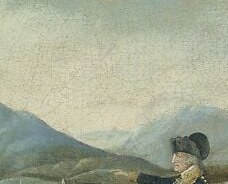
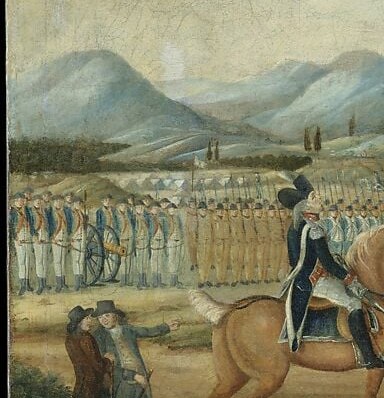
The detail that sets this painting apart from nearly every other Washington portrait of the period: the black civilian suit. Washington is not dressed as a general. The decision is deliberate, he wanted to be seen as a constitutional commander-in-chief, not a military dictator. Especially here, at Fort Cumberland, where he reviewed the troops he had just mobilized to put down the Whiskey Rebellion.
The scene is a reconstruction, not a document. Kemmelmeyer was not present at the review; he painted this years later, likely working from written accounts and his own imagination. Notice how the fort itself sits modestly in the middle distance, while the ranked blue-coated infantry and the mounted officers crowd the foreground, the painter is selling the idea of federal authority, not topographical accuracy.
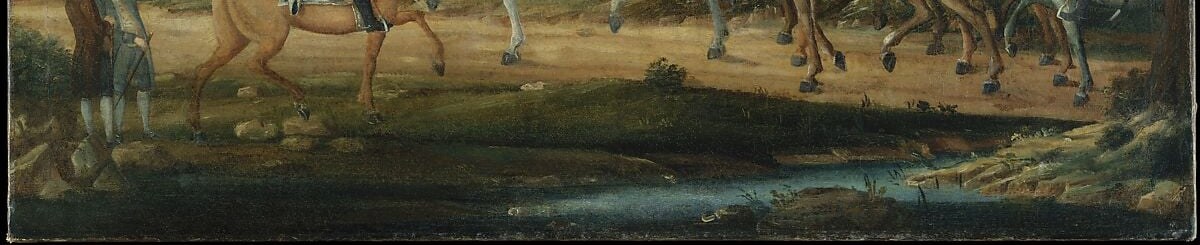
Next time you visit the Met, find this painting and stand close enough to see the ground. The scrubby, honest foreground brushwork is a folk artist's admission: this is the frontier, and order is still a work in progress.
Details
Transcript
The general wears no uniform. Just a black civilian suit. A political choice. He sent 13,000 militia to crush a rebellion over a whiskey tax. Painted years later by a man who wasn't there. Kemmelmeyer was a house painter. Entirely self-taught. Look at his left hand on the reins. A soft grip. Command without force. This folk-art record of federal power sold for nearly a million dollars.