Untitled by After Yanxiu
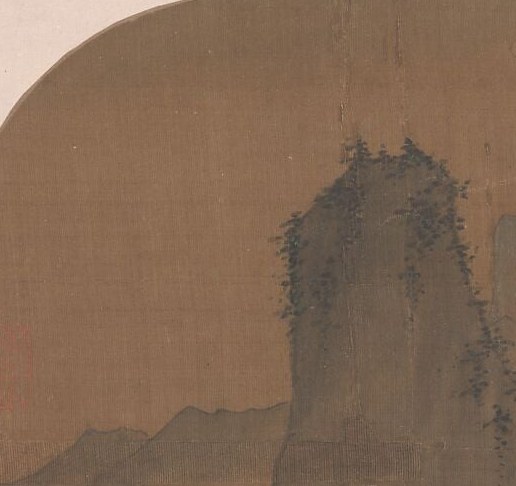
This is a Chinese landscape painting from 1506, originally a handheld fan, now mounted as an album leaf. It is ink and color on silk, and despite being more than five hundred years old, its blues and greens have held their vibrancy. The artist is recorded as 'After Yanxiu,' meaning a later painter working in the style of a tenth-century master named Yanxiu, a common and honored practice, not a forgery, but a conversation across centuries.
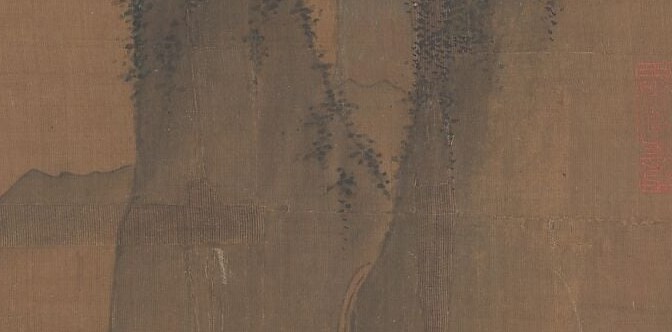
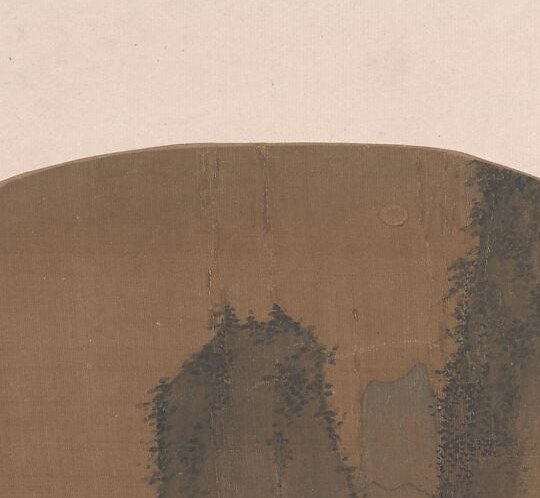
Watch the cliff face closely. The texture there is not blended or shaded the way oil paint works, it is built from calligraphic strokes called 'cun,' each one a disciplined flick of the brush that says 'this is stone.' The painter described geology with handwriting. Then look above the summit: the mist between the cliff and the distant peaks is not white paint. It is the raw silk itself, left untouched. The depth comes from restraint.
Fans like this were functional objects, held in a hand, given as gifts, annotated with poems by friends. Mounting it as an album leaf preserved it from use, turning a social object into a permanent artwork. The tiny human figures on the path would have been a private discovery for the holder, something you saw only when the fan was open in your own hands.
The most delicate passage in the entire piece is the top edge of the main summit, where dense ink thins and stops. The mountain does not end, it evaporates. That effect is only possible because of how silk absorbs the brush; paper would have bled. The whole grand scene was built to reward someone looking closely at a very small thing.
Details
Transcript
First, look at the cliff. Every stroke you see is a named technique. These lines are called 'cun', they describe stone through calligraphy, not shading. Now watch what happens above the summit. The rock stops. But the painter painted nothing. That blankness is bare silk, left empty to become cloud and depth. The deepest distance was made by doing nothing at all.