清 王原祁 輞川圖 卷|Wangchuan Villa by Wang Yuanqi
Wang Yuanqi's 'Wangchuan Villa' is a handscroll painted in 1711, now held at the Metropolitan Museum of Art. It reconstructs the legendary private estate of the 8th-century Tang poet and painter Wang Wei, a place that no longer existed when this was made. Wang Yuanqi never saw it. He knew it only through Wang Wei's surviving poems and through the accumulated visual language of the Chinese landscape tradition, which had preserved and transformed the composition across eight centuries.
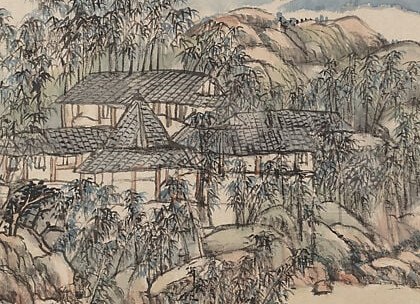
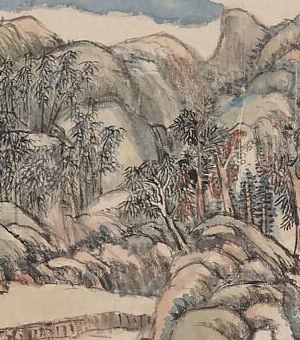
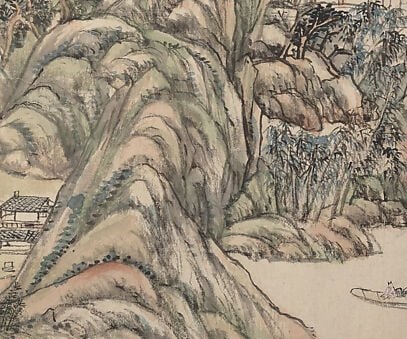
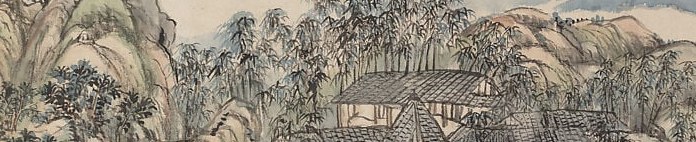
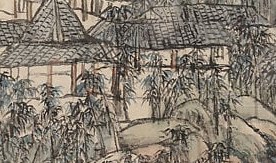
The scroll unfolds right to left, meant to be held in the hands and traveled through at arm's length. The red-lacquered gate at the pavilion entrance is the only warm accent in a palette of ink, pale color, and bare paper. The bamboo grove beside the residence signals the moral uprightness and resilience expected of a Confucian scholar. The luminous band of unpainted paper that separates the foreground rocks from the distant peaks is the mist itself, emptiness doing the work of atmosphere.
Wang Yuanqi was a leading figure of the Orthodox School and a direct heir to the theories of Dong Qichang. His brushwork here is dry and layered, building mountain volumes through accumulated strokes rather than smooth shading. The rounded boulders in the foreground are not observed from nature. They are canonical rock forms transmitted through generations of literati painters, each master citing his predecessors by the way he handled the same motifs. To paint a rock was to recite a lineage.
This is a painting about painting history. It is also a quiet act of cultural memory, a Qing scholar using ink and paper to hold a door open to the Tang dynasty, eight hundred years after the original estate returned to the earth.
Details
Transcript
The Tang Dynasty fell eight hundred years before this was painted. By 1711, the original estate was dust. Only poems survived. The bamboo still guards the scholar's gate. The painter never saw this place. He read Wang Wei's poems and rebuilt it in ink. Every rock shape here was passed down through centuries of painters. The mist is unpainted paper. The emptiness holds the mountain up. A single note of red tells you where the human life was. A Qing scholar unrolled this slowly, traveling through a Tang poet's memory with his thumb.