The Miracle of the Loaves and Fishes by Jacopo Tintoretto
View the artwork: The Miracle of the Loaves and Fishes →
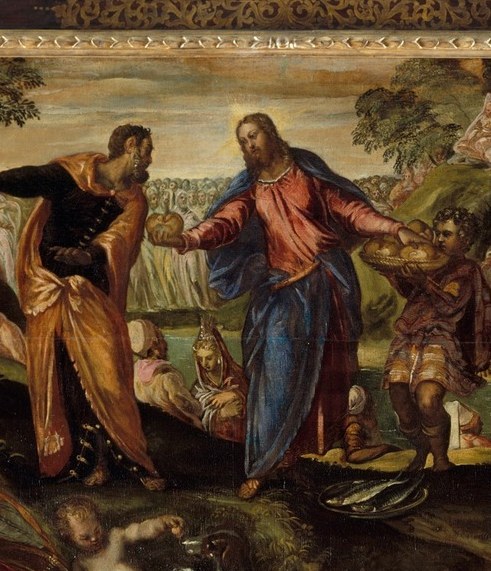
Jacopo Tintoretto’s “The Miracle of the Loaves and Fishes” (1545) is a biblical scene built with a cryptographer’s precision. The miracle of the feeding of the five thousand became, in Tintoretto’s hands, a coded statement about the sacrament of the altar, painted for a Venetian confraternity dedicated to the Holy Sacrament.
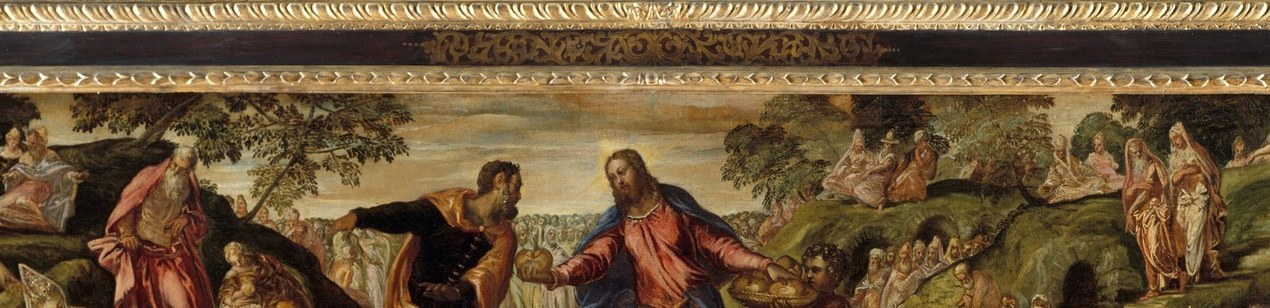
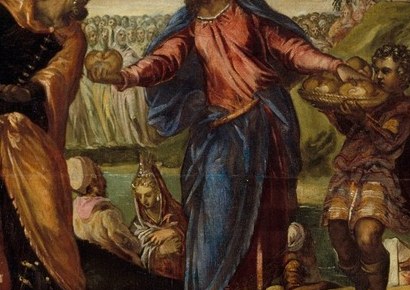
Look first at the center of the composition. The distribution of bread happens on the exact horizontal and vertical midpoint of the canvas, a deliberate staging that turns the miracle into an altar. Christ’s blue robe marks him as the divine presence, but follow the line of his arm outward and you will find the second symbol: a figure holding a fish. In the early church, the Greek word for fish, ichthys, was an acrostic for “Jesus Christ, Son of God, Savior.” Tintoretto pairs the bread and fish as a two-part key, decoding this open-air hillside into the ritual of the Mass.
Tintoretto painted this around 1545 for the Scuola del Santissimo Sacramento, a lay confraternity devoted to eucharistic devotion. The work originally hung alongside other Last Supper and miracle scenes, meaning its viewers would have immediately read the loaves as the body of Christ. The painter’s characteristic stormy sky and rushing crowd compress the supernatural and the earthly into a single dramatic plane, a technique that earned him the nickname “Il Furioso.”
A face at the far right stands apart from the crowd, watching you. He might be a donor, or he might be the artist himself, waiting to see if you found the code.
#arthistory #tintoretto #renaissance
Details

Transcript
The crowd surges around a figure in blue. His robe marks him as the divine source. The bread is placed at the exact visual center. It echoes the placement of the host on an altar. Now look beside him. The fish is not an accident. Early Christians used a fish as their secret symbol. Together, bread and fish encode the entire Eucharist.