Panoramic View of the Palace and Gardens of Versailles by John Vanderlyn
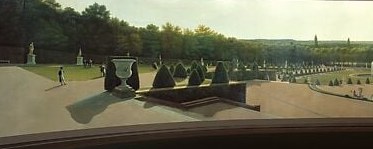
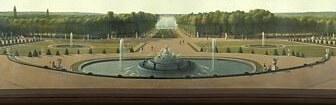
This is Panoramic View of the Palace and Gardens of Versailles, painted by American artist John Vanderlyn in 1818-19. What looks like a meticulous eyewitness record of the world's most famous palace was painted entirely from secondhand sources. Vanderlyn lived in Paris but never traveled the twelve miles to see Versailles himself.
Look at the topiary hedges and gravel parterres. They are flawless, almost mathematical. That precision is a tell: Vanderlyn based his composition on printed architectural plans and engravings, which showed the garden as Louis XIV and André Le Nôtre designed it on paper. In reality, 18th-century gardens were living, messy, seasonal things. The artist gave Americans a view of idealized geometry, not a snapshot of earth and leaves.
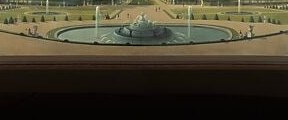
The painting was originally made for a rotunda in New York City, part of a short-lived American craze for circular panoramas. The canvas was curved to surround the viewer. It was an attraction: stand here and be transported to the gardens of a king. Vanderlyn's source material included prints circulated across Europe after the monarchy fell, images that already translated a real landscape into flattened, reproducible order. He painted those plates back into an illusion of deep space.
The result is a portrait not of a place, but of an idea: a king's absolute command rendered as straight lines vanishing to infinity, built by a republican painter who never smelled the boxwoods.
Details


Transcript
It looks like a perfect record of a real place. This is how Americans first saw Versailles. But the painter, John Vanderlyn, never set foot in France. He built everything from prints, plans, and imagination. The evidence is in the geometry. Every hedge, every path: too exact, too clean. A real eye sees mess. An engraving sees a perfect diagram. He painted Versailles as Louis XIV dreamed it, not as it was.