狩野周信筆 七福神唐子図屏風|Seven Gods of Good Fortune and Chinese Children by Kano Chikanobu
Tucked into the left margin of this glittering gold screen is a god most viewers scroll past.
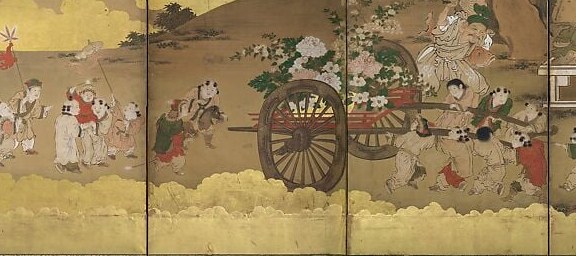
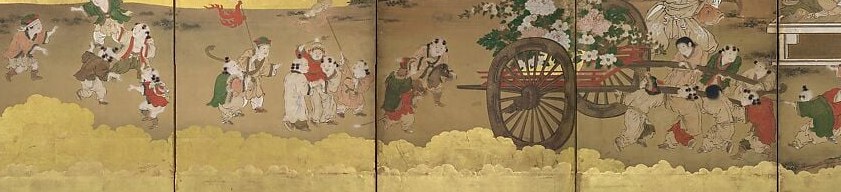
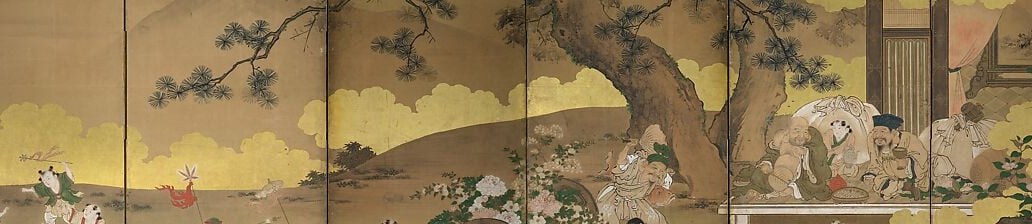
The painting is "Seven Gods of Good Fortune and Chinese Children," a six-panel folding screen by Kano Chikanobu (circa 17th to 18th century), now in a museum collection. It depicts the traditional Japanese deities of luck in a less common arrangement: on land, in a garden, playing with children in Chinese dress. The pairing emphasizes fertility, abundance, and the circulation of wealth.
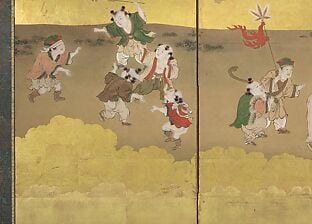
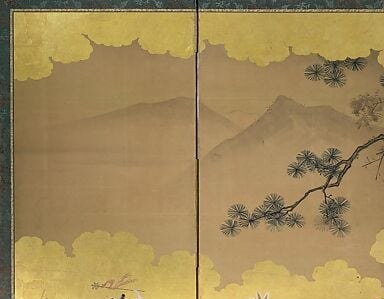
Your eye goes first to the center, where the densest group of gods and karako children tumble around a wheeled treasure cart. But the full screen reads right to left. If you trace the procession backwards, you land on a smaller cluster at the far left margin. One robed deity stands apart there. His scale and placement are so modest that at full-view he reads as part of the scenery. He is, in fact, one of the canonical Seven.
Kano Chikanobu (1660-1728) was a painter of the Kano school, the official atelier of the shogunate. Their signature was the kinpeki style: vivid mineral pigments set against luminous gold leaf. The gold is not just luxury. It fills the screen with ambient light, making the colors glow even in a dim room. The reverse side of this screen is painted too, with ink, color, and gold on paper.
Next time you see a golden screen, scan its edges. The quieter figures often hold the story together.
Details
Transcript
A parade of gods and children, bathed in gold. This is the Seven Gods of Good Fortune, but not on their ship. They are rarely painted this way, on land with playful children. The artist worked for the Kano school, masters of the golden screen. Everyone sees the main group. Now look to the far left. A smaller group sets the whole procession in motion. And there, alone at the very edge, one god easily missed.