清 佚名 舊傳顧愷之 會稽山圖 卷|The Hills of Kuaiji by After Gu Kaizhi
The Hills of Kuaiji is an 18th-century handscroll, ink and color on silk, attributed as a work after the ancient master Gu Kaizhi (ca. 344-405). The painting looks back across 1,500 years to a landscape dense with cultural memory, the Kuaiji mountains near Shaoxing, Zhejiang province.
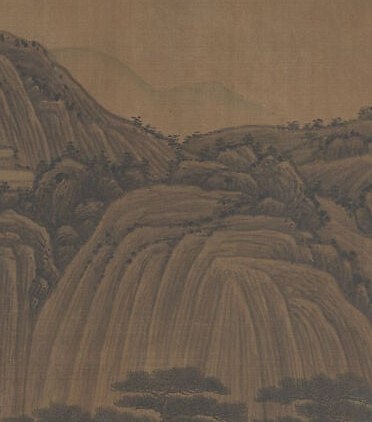
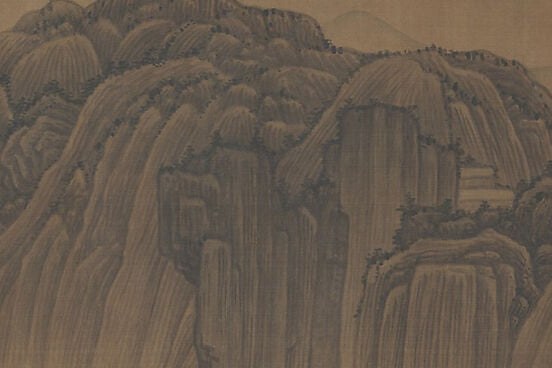
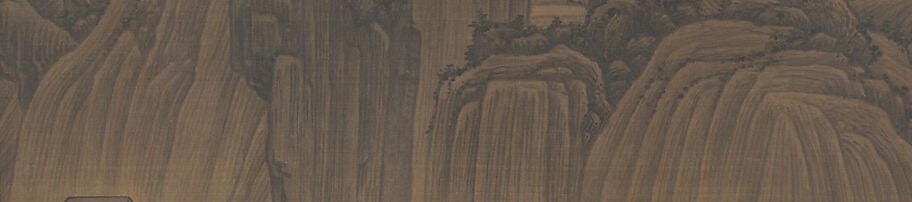
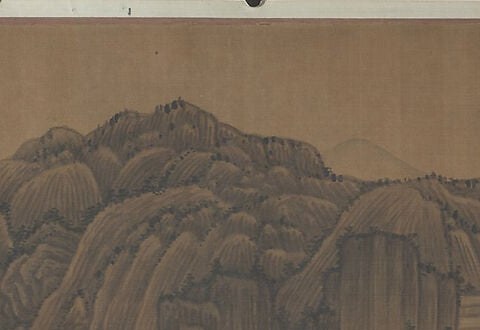
Look at how the mountain mass is constructed: the hatched hemp-fiber strokes cascading down the summit are the technical vocabulary of early Chinese landscape painting, revived here by a Qing artist deliberately working in an archaic idiom. The bare horizontal band of silk through the middle is not empty, it is the mist, and it is the most important passage in the painting. Chinese landscape convention leaves the silk untouched to represent atmosphere, and the entire composition breathes around this luminous void.
Kuaiji is the landscape of the Orchid Pavilion Gathering of 353 CE, when Wang Xizhi and forty-one other scholars drifted wine cups down a winding stream and composed poems on the mountainside. That event became the foundational myth of Chinese literati culture. An 18th-century painter walking these hills and painting them in the manner of Gu Kaizhi, a master from Wang Xizhi's own century, is not copying. It is a conversation across time, a claim that this ground is still sacred.
The painting belongs to the long tradition of Chinese handscrolls that invite the viewer to travel through a landscape rather than merely look at it. Where would your eye rest first if you could unroll this scroll in your hands?
Details

Transcript
This is Kuaiji, in southern China. Poets climbed these slopes in the year 353. They wrote verses by a stream, drunk on wine. The painter builds the mountain with hemp-fiber strokes. A band of bare silk becomes the mist. He painted this 1,500 years after the poets. And signed it with a name from their century.