Bodegón con pichones cesta de comida y cuencos by Luis Egidio Meléndez
Luis Egidio Meléndez, a master of Spanish still life, created *Bodegón con pichones cesta de comida y cuencos* (Still Life with Pigeons, Food Basket, and Bowls) around 1750. While seemingly a simple arrangement, Meléndez elevated everyday objects through his precise rendering of light and texture, transforming common kitchen fare into compelling art. It is now held in the collection of the Museo del Prado.
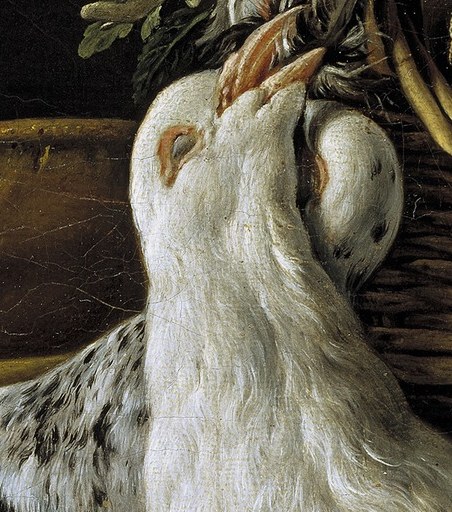
Observe the meticulous detail given to each item: the golden crust of the bread, the papery skins of the onions, and the delicate feathers of the dead pigeon. The artist's skill makes each surface tangible, from the polished lemon to the rustic weave of the basket.
Yet, a fascinating, easily missed detail lies in the lower left corner. Faintly inscribed on the table are the numbers '7' and '586'. These subtle marks are likely inventory or catalog numbers, offering a quiet glimpse into the painting's long journey through various collections before finding its home in the Prado.
Meléndez, though largely unappreciated in his lifetime, is now celebrated as one of the 18th century's finest still-life painters. What stories do you think these hidden numbers could tell?
Details

Transcript
This Spanish painter made everyday objects feel monumental. See how light defines the textures of the food. He captures the softness of feathers, the glint of a knife. Yet, most people miss a tiny detail right here. Look closely at the table's lower left corner. A small '7' is faintly inscribed on the surface. And just beside it, the number '586' appears. These might be inventory marks, a hint at its long history.