An Arctic Summer: Boring Through the Pack in Melville Bay by William Bradford
View the artwork: An Arctic Summer: Boring Through the Pack in Melville Bay →
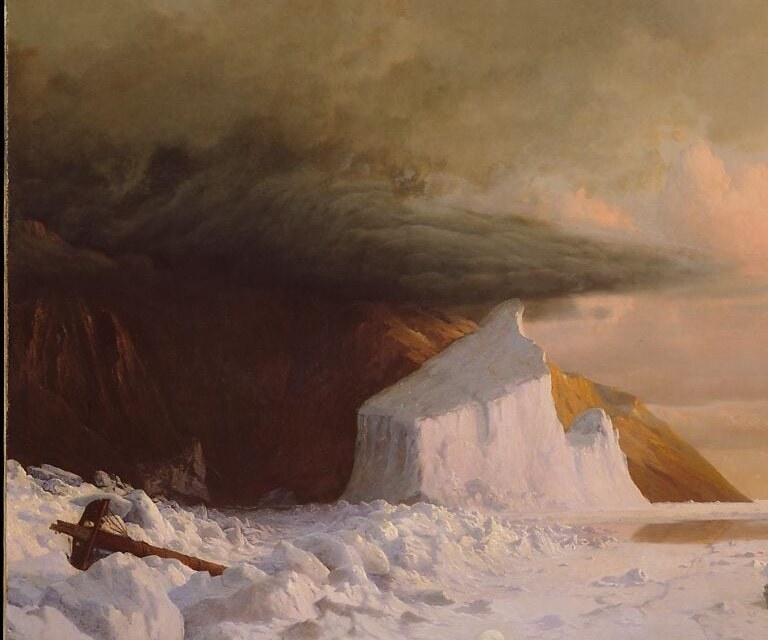
William Bradford painted "An Arctic Summer: Boring Through the Pack in Melville Bay" in 1871, and he knew exactly what he was looking at. Two years earlier, in 1869, Bradford had sailed to Greenland on an expedition led by the Arctic explorer Isaac Hayes. The painter stood on deck, making sketches and photographs of icebergs, pack ice, and the ship fighting its way through. This is not an imagined scene. It is a witness report, executed in oil on canvas.
The painting's argument lives in scale. Bradford gives the iceberg cliff almost the entire left half of the frame, its blue-white face banded with ancient strata. Against it, the three-masted vessel is a few thin strokes of dark paint. The open water channel in the middle right, which Arctic navigators called a "lead," is the ship's only hope. Bradford makes that lead read as a dark corridor, and beyond it, a thin band of amber light glows on the horizon. That warmth is visible but unreachable.
The work is now housed in the Metropolitan Museum of Art's American Wing. Bradford himself grew up in Fairhaven, Massachusetts, painting the ships of New Bedford Harbor. After his Arctic expeditions, he became famous for these polar scenes, which were treated as near-documentary records in an era before photographs could capture color or scale. His ice is built up in thick impasto, a tactile crust of paint that gives the berg its material weight.
A painting like this asks what it meant to take a wooden-hulled ship into ice that could crush it. Bradford shows you the answer without speaking. He was there.
#arthistory #williambradford #arcticexploration
Details


Transcript
Summer, 1869. Melville Bay, Greenland. A ship bores through the pack ice. The painter was on this expedition. This is what he saw. The ice cliff towers. The ship is a splinter. See the dark channel? Arctic sailors called that a lead. The only warmth is a horizon the ship cannot reach.