Artwork
An Arctic Summer: Boring Through the Pack in Melville Bay
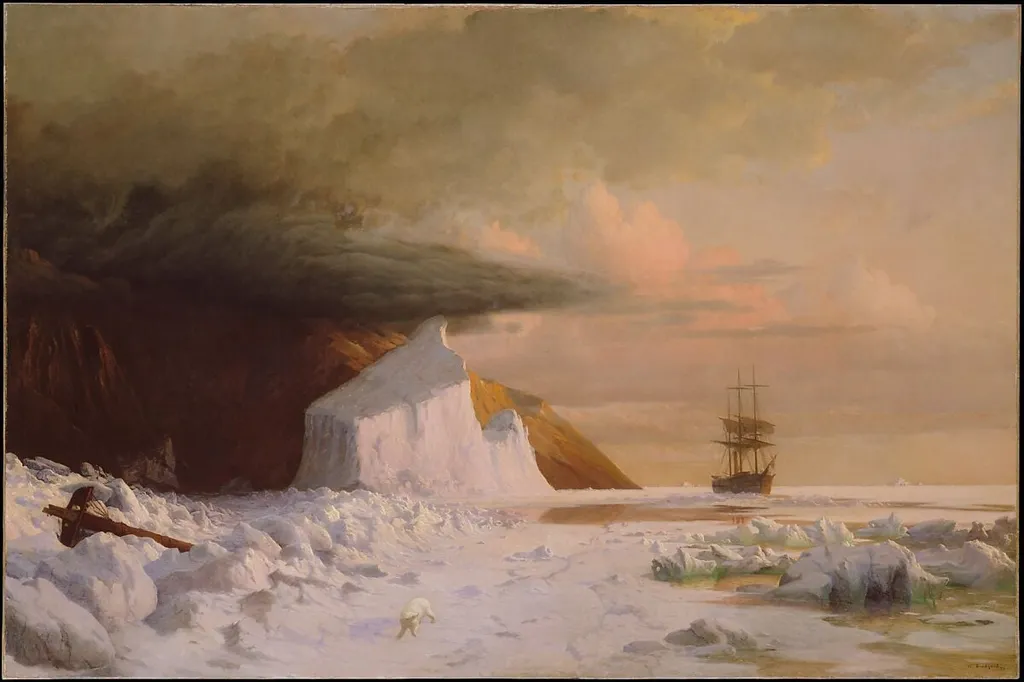
An Arctic Summer: Boring Through the Pack in Melville Bay is an oil painting by the American Impressionist artist William Bradford. It dates from 1871 and is held in the collection of the Metropolitan Museum of Art.
About this work
Overview
William Bradford, who personally participated in Arctic expeditions, renders the scene with meticulous attention to the physical realities of the voyage.
Painted in 1871, An Arctic Summer: Boring Through the Pack in Melville Bay depicts a three-masted whaling vessel navigating the treacherous ice fields of Melville Bay in Greenland. The composition centers on the ship wedged tightly between towering, jagged icebergs, emphasizing the immense scale of the Arctic environment against human endeavor. William Bradford, who personally participated in Arctic expeditions, renders the scene with meticulous attention to the physical realities of the voyage.
The hull appears scarred from the pressure of the pack ice, while the rigging and deck details reflect the specific conditions of a working vessel in the high latitudes. The palette is dominated by cool tones, with the ice glowing in shades of blue and white under a pale, expansive sky, creating a sense of atmospheric stillness and isolation. This work exemplifies Bradford's mature style, merging the grandeur of the Hudson River School with a documentary approach to maritime subjects.
It stands as a significant contribution to American Arctic painting, capturing both the aesthetic beauty and the perilous nature of 19th-century polar exploration.
Subject & Meaning
The painting captures a ship's arduous journey through the dense ice floes of Melville Bay. A three-masted vessel is shown wedged amidst towering, jagged icebergs, their surfaces glowing with blue-white light. The ship's hull bears visible scars, evidence of its struggle against the frozen pack.
This depiction emphasizes the formidable power of the Arctic environment and the persistent human endeavor to traverse its remote and challenging waters.
Technique & Style
William Bradford's artistic approach in this work is characterized by a commitment to realism, informed by his direct observation. He rendered intricate details, such as the ship's rigging, rust marks, and the specific tilt of the ice formations, with precision. The artist employed thick, textured brushstrokes, known as impasto, particularly for the ice.
This technique creates a tactile quality, enhancing the visual impression of coldness and the material presence of the frozen landscape.
Context
This painting is a direct result of William Bradford's firsthand involvement in Arctic expeditions. Unlike artists who might imagine such scenes, Bradford traveled to the polar regions himself, making numerous sketches while on deck. These on-site observations provided the foundation for his studio paintings, ensuring an accurate and immediate portrayal of the harsh conditions and unique beauty of the Arctic environment, rather than relying on generalized recollections.
Artist & collection

Artist
William Bradford (April 30, 1823 – April 25, 1892) was an American romanticist painter, photographer and explorer, originally from Fairhaven, Massachusetts, near New Bedford.

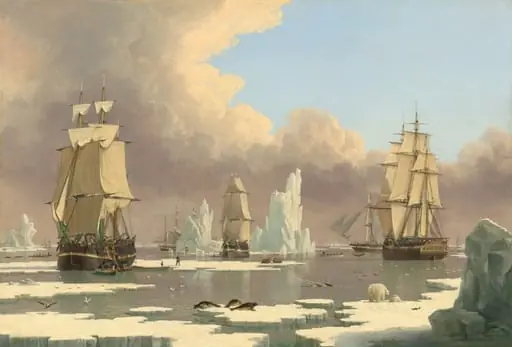 The Northern Whale Fishery: The "Swan" and "Isabella"
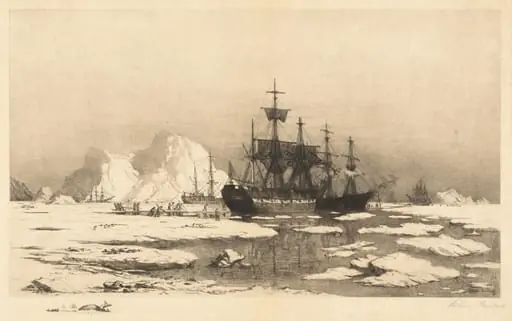 Among the Ice Floes
 Midnatsstemning ved den grønlandske kyst
 Midnatsstemning ved den grønlandske kyst
 Ships in Ice off Ten Pound Island, Gloucester
 Czarny Staw (The Blake Lake) – Blizzard
 Panserskibet "Iver Hvitfeldt" passerer Forbjerget Stat på vejen til Trondhjem i sommeren 1893
 Boston Harbor
 Wild Weather