After a Long Cruise by John Carlin
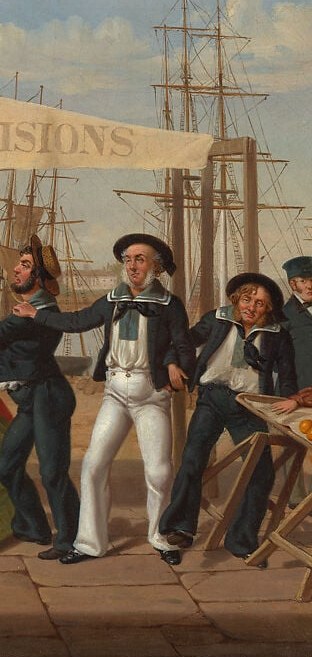
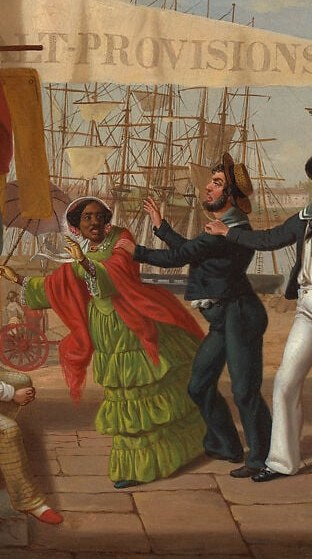
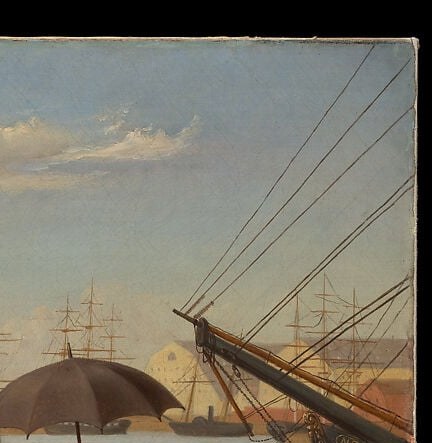
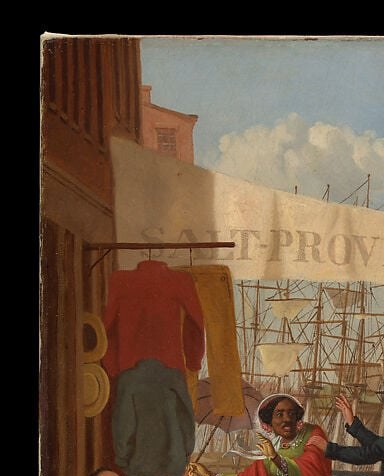
John Carlin's "After a Long Cruise" (1857) lives in the American Wing of the Metropolitan Museum of Art, and at first glance it is a warm homecoming scene: a sailor in crisp white returns to a woman in a brilliant orange-red dress. The dock is busy, the fruit is abundant, the sky is open. But Carlin was not just painting a welcome. He was an outsider painting a welcome, and that changes everything.
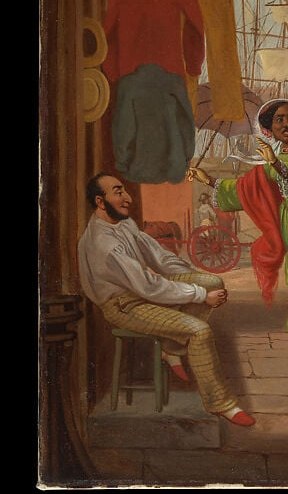
Let your eye drift to the far left edge. A Black dock worker stands there, almost out of the frame. His face is painted with as much care as the central sailor's. Carlin, who lost his hearing as a child and became the first published deaf poet in the United States, knew what it meant to be kept at the edge of a room while life happened in the center. The composition is not an accident. It is an argument.
The painting dates from 1857, four years before the Civil War. American port cities were built on maritime trade, and that trade was tangled up with slavery and the economies it fed. The man at the margin is not a symbol; he is a documented presence, a person on a working dock, and his placement on the literal edge of the canvas is Carlin's quiet editorial. The sailor is embraced. The provisions are plentiful. The Black dock worker is present but not included, visible, but pushed aside.
Carlin knew that the center is a privilege. He gave the sailor the white uniform and the bright welcome, but he gave the margin to the man history would have erased. Look again at the crowd, the fruit, the brick warehouses. The painting's real subject is the edge.
Details
Transcript
He's back. White uniform, solid ground. She meets him in a dress the color of flame. John Carlin painted this in 1857, after he lost his hearing as a child. He became America's first published deaf poet. Now look at the far left edge. A Black dock worker, painted into the margin. Carlin, himself an outsider, made the composition his argument. The welcome is warm. It is not for everyone.