View near Sherburne, Chenango County, New York by Jasper Francis Cropsey
This is "View near Sherburne, Chenango County, New York," painted by Jasper Francis Cropsey in 1853. Cropsey was a trained architect who became a leading figure in the Hudson River School, and this canvas is a quiet masterclass in spatial illusion. He takes an unremarkable stretch of farmland in upstate New York and turns it into a demonstration of how paint alone can compress miles of air and light onto a flat surface.
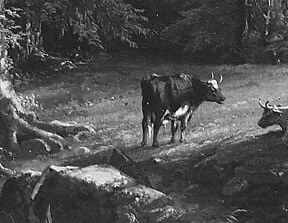
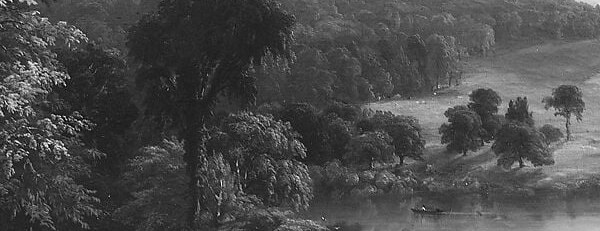
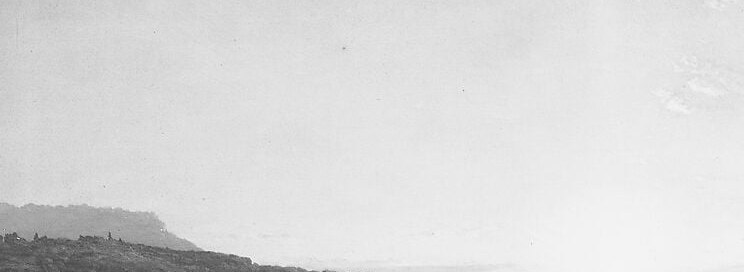
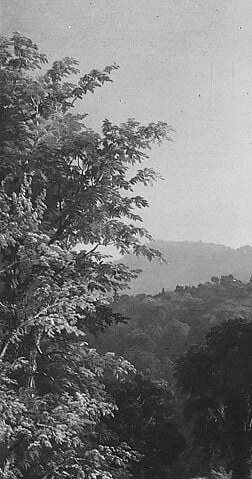
Watch the rocks in the immediate foreground, dark, crisp, every fissure articulated. Then let your eye travel to the lake: the contrast drops, the edges blur, a pale haze settles over the water. By the time you reach the distant plateau, the ridge is so close in value to the sky that the horizon nearly melts. Cropsey is not copying nature; he is translating depth into a tonal sequence.
He painted this the year after his marriage, settling into a new life. The scene is local and personal, specific enough that the flat-topped ridge would have been recognizable to anyone in Chenango County. But the subject is secondary to the method. The white cow, the split-rail fence, the cleared pasture between rocky foreground and wooded ridge: all of them are stations on a journey from near to far, each calibrated to the exact amount of atmosphere that three miles of air would put between you and the view.
The painting lives in that thin band of hazy light behind the ridge line, the place where land and air become one value. Cropsey knew that atmosphere is the true subject of any landscape, and here he made it visible.
Details

Transcript
A valley in upstate New York, 1853. Start at your feet. Dark. Sharp. Every crack and moss-tuft catches the light. Now the middle ground. The tone lifts. Edges soften. A veil of atmosphere sits on the water. Now the far ridge, three miles away. Nearly the same value as the sky. No sharp line separates them. Cropsey called this "atmospheric perspective."