Untitled by Nainsukh
In the Himalayan foothills around 1780, the painter Nainsukh made this battle scene small enough to hold in one hand. It is ink and ocher on paper, and it packs a full cosmology into a few square inches.
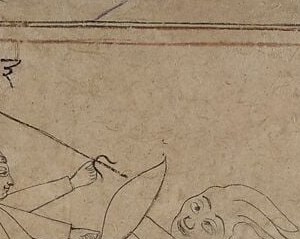
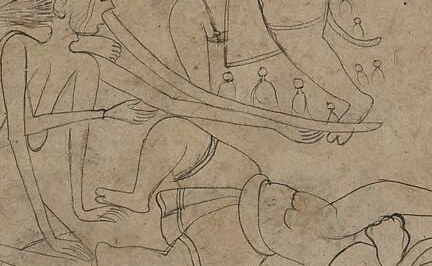
The elephant at the center is not a symbol. War elephants were prestige weapons in 18th-century South Asia, living siege engines that could break infantry lines. Nainsukh gives its tusks and raised trunk extraordinary attention, and if you move in close, you can see how he built shadow across its head with thousands of tiny crisscrossed lines, a technique like cross-hatching, applied with a brush so fine the marks are still crisp after nearly 250 years.
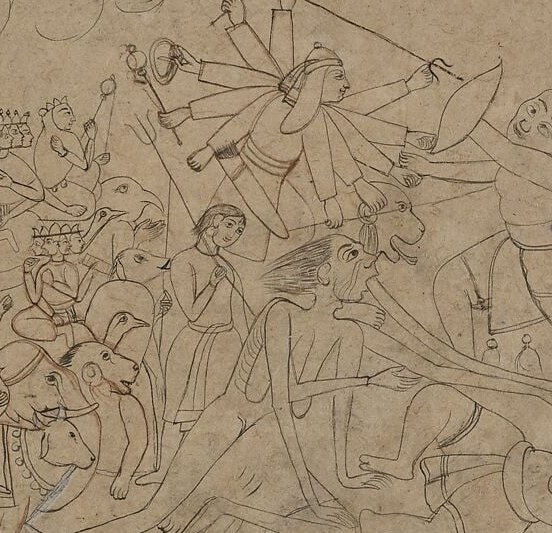
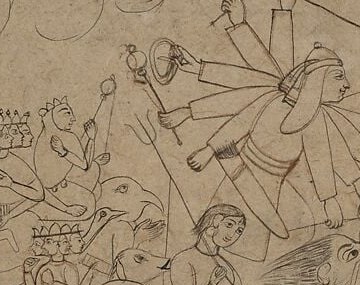
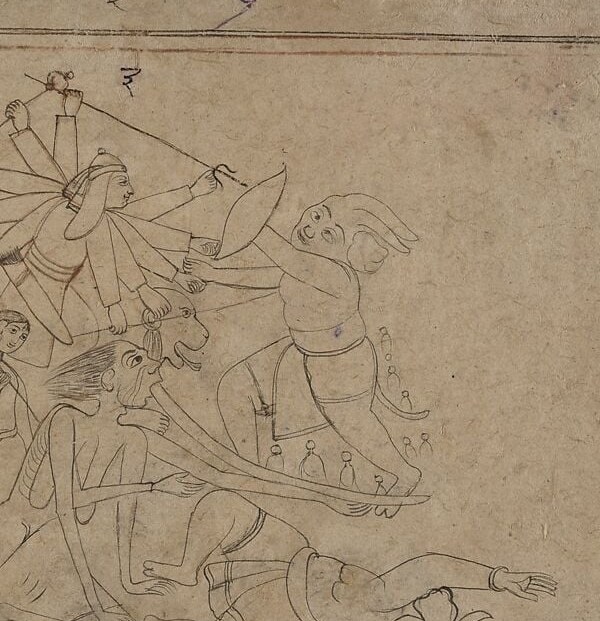
The scene is a melee: cavalry, foot soldiers, a tower at the margin suggesting a siege. But this is not a historical battle. A multi-armed goddess rides into the center of it. Her eight hands each hold a weapon radiating outward. Beneath her is a lion, her vahana, her divine vehicle. That identifies her as Durga, and the figure fallen at her feet is the buffalo demon Mahishasura, already defeated. The painting does not separate the human from the divine. The soldiers wear the armor and ride the horses of Nainsukh's own time, and the goddess shows up in their actual battlefield as warranty, not metaphor.
Nainsukh worked for the royal courts of the Pahari hills, and his style valued precise line over heavy color. This untitled work now lives in the collection of the Metropolitan Museum of Art.
Details
Transcript
A battle scene, small enough to hold in one hand. The elephant at the center is not a symbol. It was the tank of its day. Look at the precision in the tusks and the raised trunk. The artist built shadow with thousands of tiny crisscrossed lines. And there is the reason this fight is not just a fight. A goddess rides into the center, eight arms bristling with weapons. Beneath her: a lion. Her mount. This is Durga. And at her feet, a fallen figure. The demon, already over.