Strawberry Pedlar by William P. Chappel
Strawberry Pedlar, painted in the 1870s, is one of a set of small, precious street scenes made by William P. Chappel. It lives in the American Wing of the Metropolitan Museum of Art. Chappel, who lived from 1801 to 1880, spent a good part of his life documenting the ordinary people and unadorned corners of a New York that was changing too fast for anyone to properly notice. He painted on slate paper, a frugal, durable surface that gave his work the soft, chalky feel of a quick sketch, an immediacy that suits his subject perfectly.
Look at the pedlar herself. She does not call out to you. She does not hold out the tray. She simply walks, a solitary figure in the center of a wide dirt road, flanked by a wooden house on one side and a new industrial building on the other. Her posture is straight, her head level. The strawberries are at her chest height, a weight she carries as a matter of course. The open sky and long tree shadows make the street feel suspended in a silent, workaday heat. A dog trots beside her, and a neighbor stands near the left building. Life continues; she walks through it.
A pedlar in 1870s Brooklyn occupied a precarious economic position. With no storefront and no fixed income, she relied entirely on her feet and her sales. The painting does not dramatize her situation. Instead, Chappel treats her with the same quiet, attentive dignity he gave every newsboy, knife-grinder, and oyster-seller he ever painted. He was not a famous man, and he did not paint famous things. He painted what was real, before it vanished under brick and pavement.
She is crossing a dirt road that no longer exists, in a city that no longer looks like this. And Chappel saw her, named her, and remembered.
Details
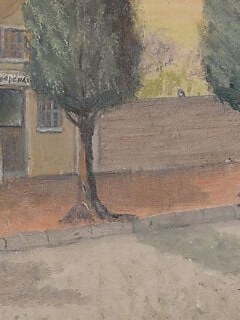
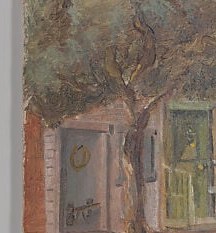
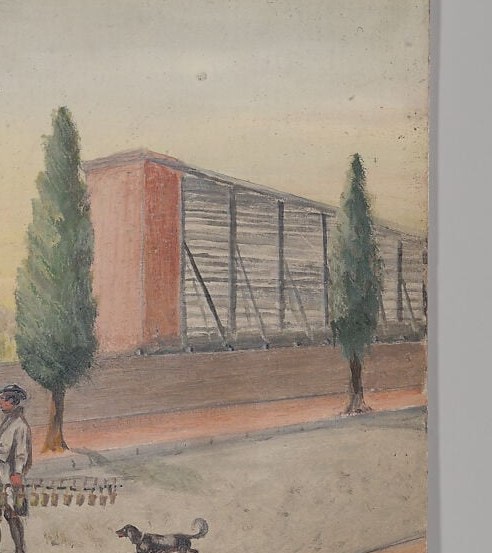
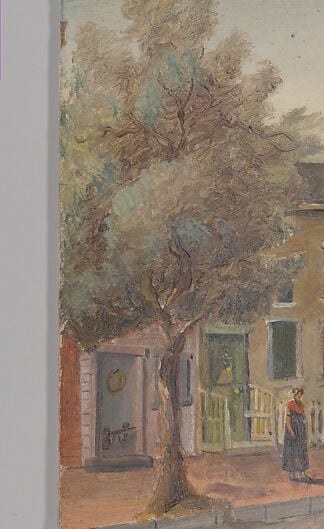
Transcript
She walks alone, mid-road, in 1870s Brooklyn. Look at how the street widens around her. No carriage, no crowd. Just dirt and daylight. She carries a tray of strawberries at her chest. Her posture is straight, her head steady. The painter, William Chappel, called her a pedlar. It meant itinerant work. No store, no stall, no safety. Chappel painted only one thing: the unadorned, working New York.