Fighting a Fire by William P. Chappel
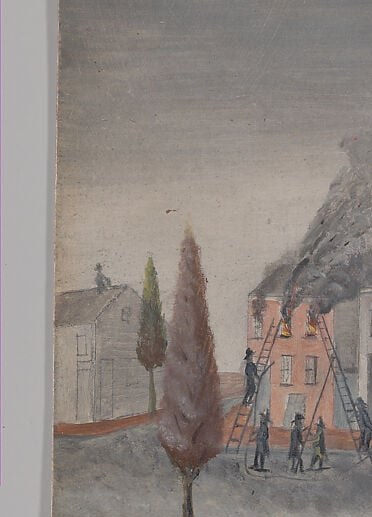
This is William P. Chappel's "Fighting a Fire," painted on slate paper in the 1870s and now in the collection of The Metropolitan Museum of Art's American Wing. The painting captures a New York City street scene at night, with a wooden building fully ablaze while firefighters work to contain the destruction.
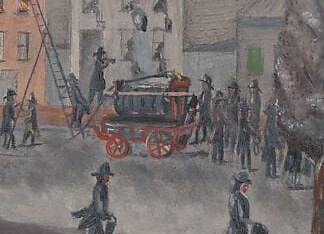
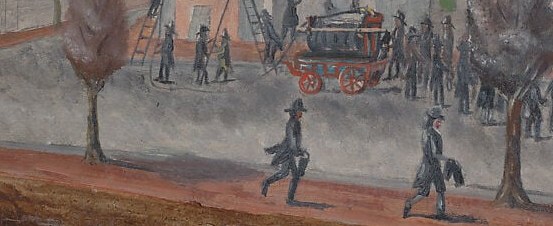
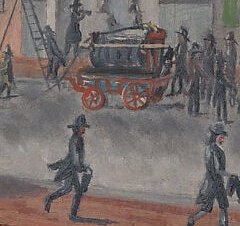
Look first at the hand-pumper engine in the middle of the street. That machine, operated by men working physical handles, is the technological timestamp for this entire scene. The leather hose snaking toward the flames draws water not from a pressurized hydrant but from a street cistern. The helmeted figure near the engine wears the uniform of a volunteer department, identifiable by the specific shape of his headgear.
This method of firefighting was on the verge of extinction. By the 1880s, steam-powered engines replaced hand-pumpers across New York's fire departments. Chappel, a sign painter by trade, recorded the equipment with the precision of a man used to rendering objects clearly and legibly. His choice of slate paper gives the surface an unusual smoothness, making the flames and reflections on the wet street feel almost metallic.
A volunteer system, a leather hose, a hand-pumped stream of water, a row of Federal-style buildings on an unpaved street. The painting is not just a dramatic scene. It is an inventory of a world that ended almost as soon as it was painted.
Details
Transcript
A house is fully engulfed. The fire has already won. But the machine in the street is what dates this scene exactly. It is a hand-pumper. No steam. Just men pumping handles. They run a leather hose toward the blaze. This predates fire hydrants. The water came from a cistern. That helmeted man is the clearest figure. A volunteer, not a paid firefighter. Within ten years of this scene, steam engines replaced hand-pumpers entirely. This painting is the last record of a system about to vanish into smoke.