Berg's Ship Yard by William P. Chappel
William P. Chappel's small oil painting, Berg's Ship Yard, held by the Metropolitan Museum of Art, is a remarkably precise record of a working 1870s New York waterfront. Chappel painted it not on canvas but on slate paper, an ultra-smooth surface that let him capture the glint of a belt buckle or a wood chip without any interfering brush texture.
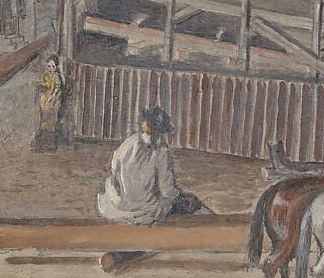
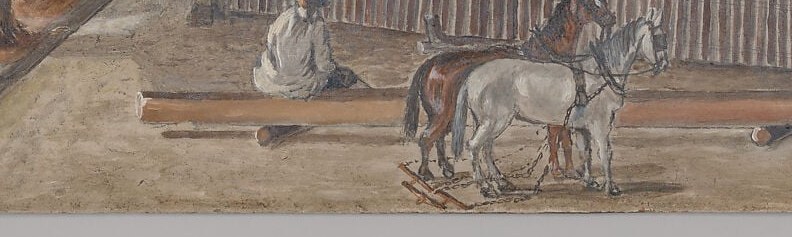
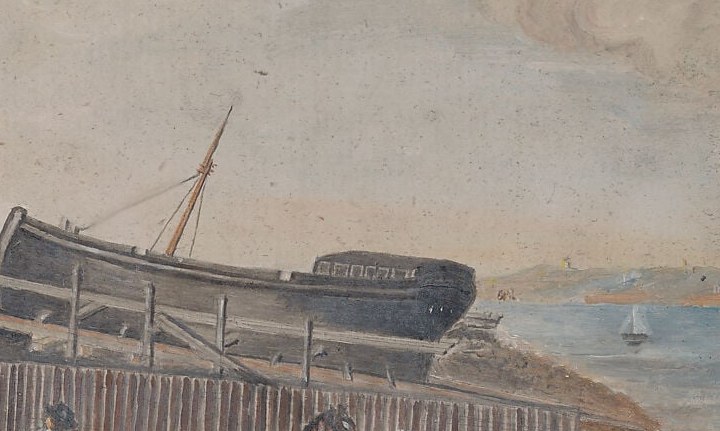
Look for the white horse standing in the left foreground. It anchors the human scale of the operation, a reminder that before steam, heavy haulage in a shipyard depended on animals. Behind the horse, the great dark hull is propped on a wooden dry dock cradle, an accurate document of the engineering used before steel slipways. The foreground is especially rewarding: trampled earth, scattered timber offcuts, and planking prove this is a functioning yard caught mid-repair, not a memorial portrait.
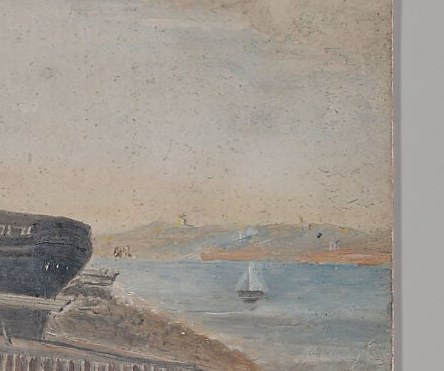
Chappel was an amateur New York artist who lived from 1801 to 1880. He produced a series of small views of the city’s working waterfronts at a moment when sail was giving way to steam. Berg's Ship Yard captures that transition indirectly. The vessel hauled out for repair still carries a full mast and rigging, but the commercial urgency implied by the distant sailing vessels on the harbor suggests why a yard like this was vital to trade.
The painting’s calm, even light and its careful construction details make it feel almost like a piece of industrial archaeology. What other trades do you think vanished before anyone thought to record them this carefully?
Details
Transcript
It looks like a ship, hauled onto dry land. New York, the 1870s. The waterfront was the city's engine. A white horse was the horsepower of the pre-steam yard. Now look at the ground beneath the hull. Trampled earth, scattered timber offcuts. Active work, not a posed view. The artist painted this on a slab of slate paper. No canvas grain. Every splinter and buckle could be recorded.