The New Bonnet by Eastman Johnson
View the artwork: The New Bonnet →
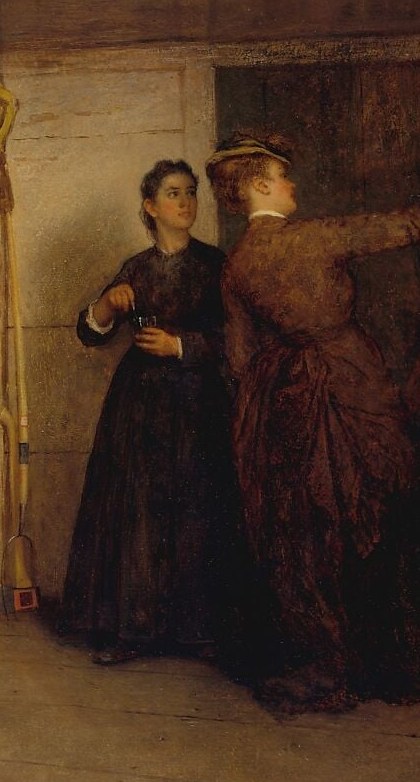
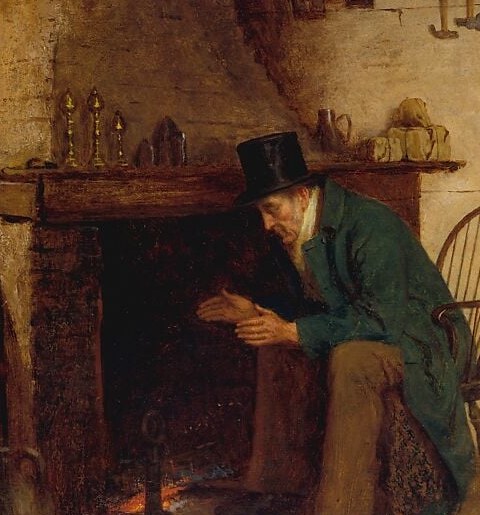
Eastman Johnson's The New Bonnet (1876) hangs at the Metropolitan Museum of Art, a small oil on academy board that captures a moment of quiet generational shift. Painted during the American Centennial summer on Nantucket, it shows a young woman lifting a fashionable new hat while her plainly dressed companion watches and an older man warms his hands at the fire, his back to the whole exchange.
Johnson, known in his day as The American Rembrandt, built the scene around competing light sources: the warm hearth glow behind the seated man and the cool daylight striking the younger woman's face. Her raised arm and confident posture make her the compositional anchor. The new bonnet itself, plumed and veiled, floats above the rough wooden floor and simple Windsor chair like an object from a different century.
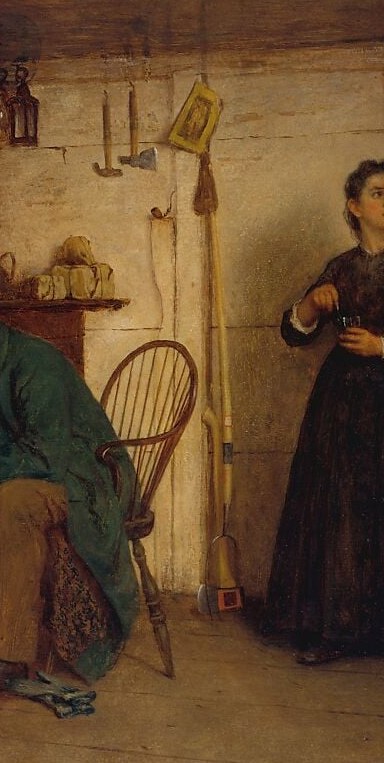
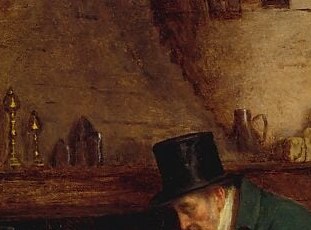
But the painting rewards a slower look. Past the three figures, the kitchen's back wall and upper-left corner hold the accumulation of an older life: hanging utensils, shadowed shelves, indistinct pots. Johnson painted this Nantucket interior from real observation, summering on the island throughout the 1870s after it had faded as a whaling port. The clutter is genuine, not stagecraft, and it anchors the room in a working existence the new bonnet is poised to leave behind.
The work arrived at the Met in 1900 through the bequest of railroad magnate Collis P. Huntington. Since then it has appeared in major retrospectives at the Brooklyn Museum, the Whitney, and the Met itself. Next time you stand before it, let your eye drift past the figures into the shadows. What else is back there?
#arthistory #eastmanjohnson #americanpainting
Details
Transcript
We're in a Nantucket kitchen, 1876. The American Centennial summer. A nation trying on new things. A young woman shows off a plumed new bonnet. Her companion watches, quiet, in an old plain dress. The father warms his hands at the fire, turned away. But the real story of this house is behind them. Look into the dark, upper-left corner. Shadowed shelves, pots, the clutter of a long, working life.