Artwork
The New Bonnet
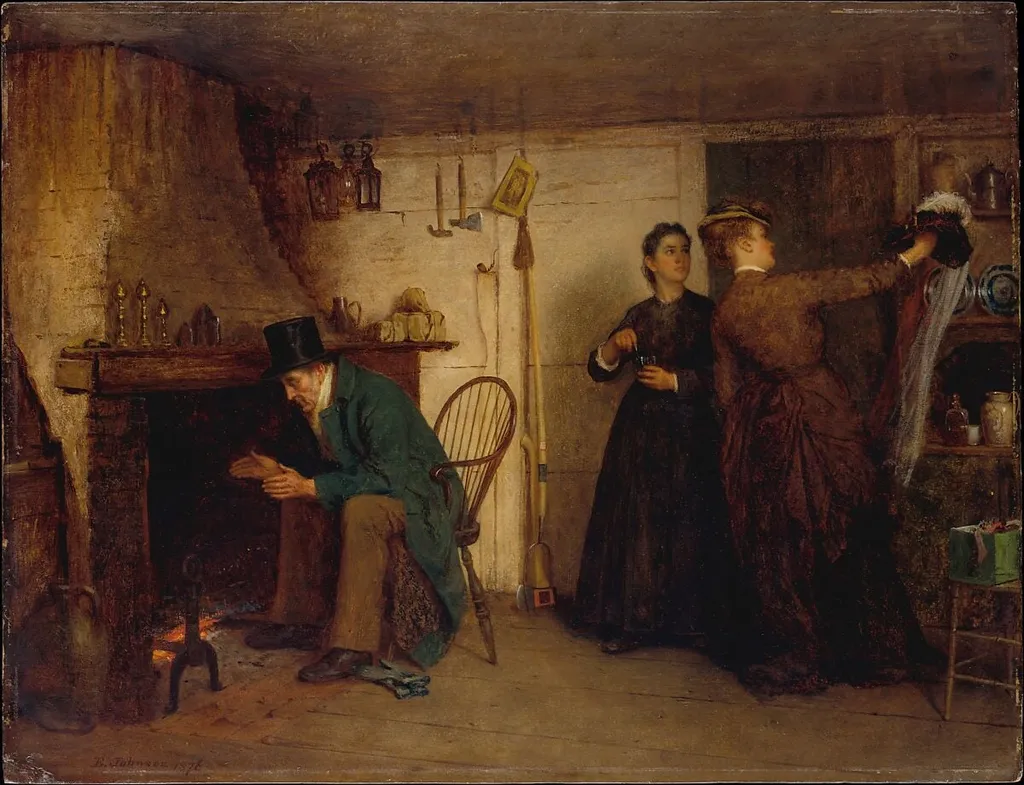
The New Bonnet is an oil painting by the American Impressionist artist Eastman Johnson. It dates from 1876 and is held in the collection of the Metropolitan Museum of Art.
About this work
In an old-fashioned Nantucket kitchen, a young woman in a plumed, veiled hat turns to her plainly dressed sister while their father warms his hands by the fire. Eastman Johnson painted it in 1876, the year of the American Centennial. Collis P. Huntington bequeathed the work to the Metropolitan Museum of Art in 1900.
Subject & Meaning
This juxtaposition of the delicate bonnet with rough implements of labor and hunting suggests a narrative about simple pleasures amid everyday rural life.
The painting depicts a domestic interior featuring a man and a woman, with the woman likely presenting a new bonnet as the focal point of the scene. Surrounding them are objects typical of a rustic household: a fireplace, andiron, candlestick, and lantern on the mantel, alongside tools such as an axe, hammer, and pitchfork, and personal items like a pipe, top hat, overcoat, and glove. This juxtaposition of the delicate bonnet with rough implements of labor and hunting suggests a narrative about simple pleasures amid everyday rural life.
The bonnet, a fashionable accessory, may symbolize a modest luxury or a gift, while the hearth and tools anchor the scene in a context of domesticity and subsistence. The work thus captures a quiet moment of pride or exchange, reflecting the artist's interest in American genre scenes that celebrate the commonplace.
Technique & Style
Executed in oil on academy board, a prepared support typical of 19th-century American painting, the work measures 52.7 × 68.6 cm. The composition is a domestic interior crowded with period objects, bonnet, fireplace, tools, and clothing, consistent with Eastman Johnson's genre scenes. The medium and support suggest a relatively stable surface for the artist's detailed rendering of textures and materials. No specific information on handling, brushwork, or condition is provided in the available sources, but the work's formal qualities align with Johnson's documented realist approach to everyday life.
Overview
Eastman Johnson's 1876 painting, The New Bonnet, rendered in oil on academy board, portrays a domestic moment in a rustic kitchen. It shows a young woman presenting a fashionable new hat to a companion, while an older man warms himself by the fire. The work subtly highlights the cultural tensions between traditional rural life and the emerging consumerism of post-Civil War America.
Context
Created in 1876, the year of the American Centennial, The New Bonnet draws from Eastman Johnson's experiences on Nantucket. During the 1870s, he regularly summered on the island, a former whaling port, finding artistic inspiration in its blend of Greek Revival architecture and humble coastal dwellings. This setting provided a backdrop for exploring the nation's evolving identity after the Civil War.
History & Provenance
This painting debuted in 1876 at the National Academy of Design's annual exhibition in New York, the same year it was completed. Its journey into the Metropolitan Museum of Art's collection occurred in 1900, as part of the significant bequest from Collis P. Huntington. Huntington, a prominent railroad industrialist, was also a notable art collector of his time.
Legacy
Over the decades, The New Bonnet has been included in several significant exhibitions dedicated to Eastman Johnson's oeuvre. These retrospectives include showings at the Brooklyn Museum of Art in 1939 and again in 1999, the Whitney Museum of American Art in 1972, and the Metropolitan Museum's comprehensive 2010 exhibition on American genre painting.
Artist & collection
Artist
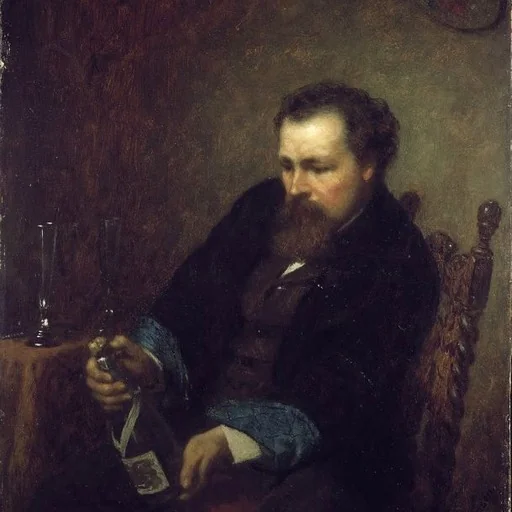
Jonathan Eastman Johnson (July 29, 1824 – April 5, 1906) was an American painter and co-founder of the Metropolitan Museum of Art, New York City, with his name inscribed at its entrance.

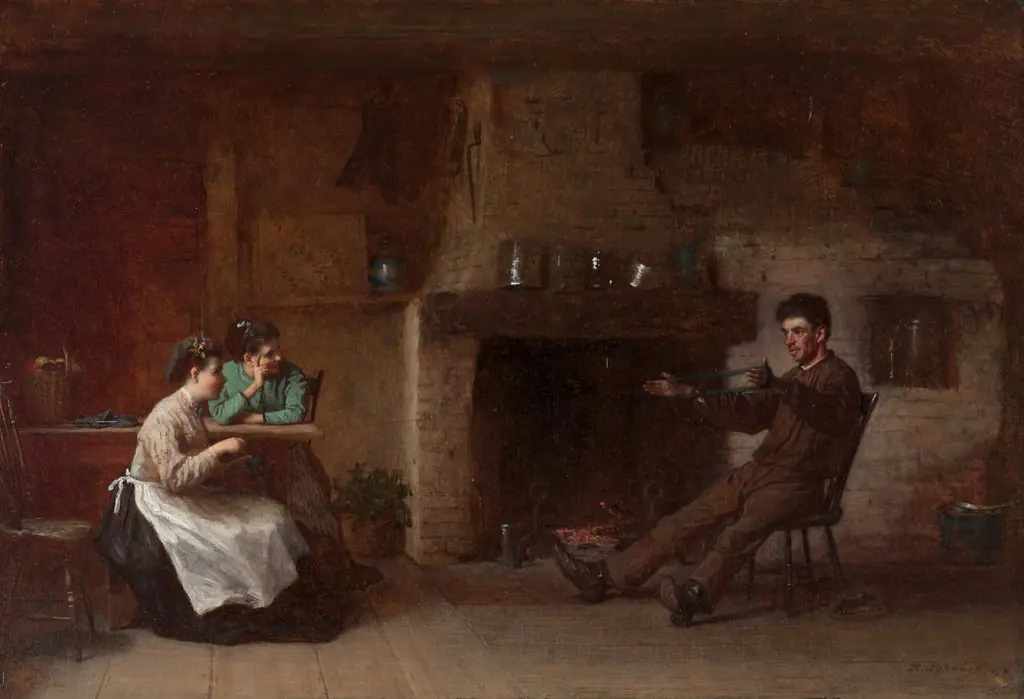
- Winding Yarn (Interior of a Nantucket Kitchen)
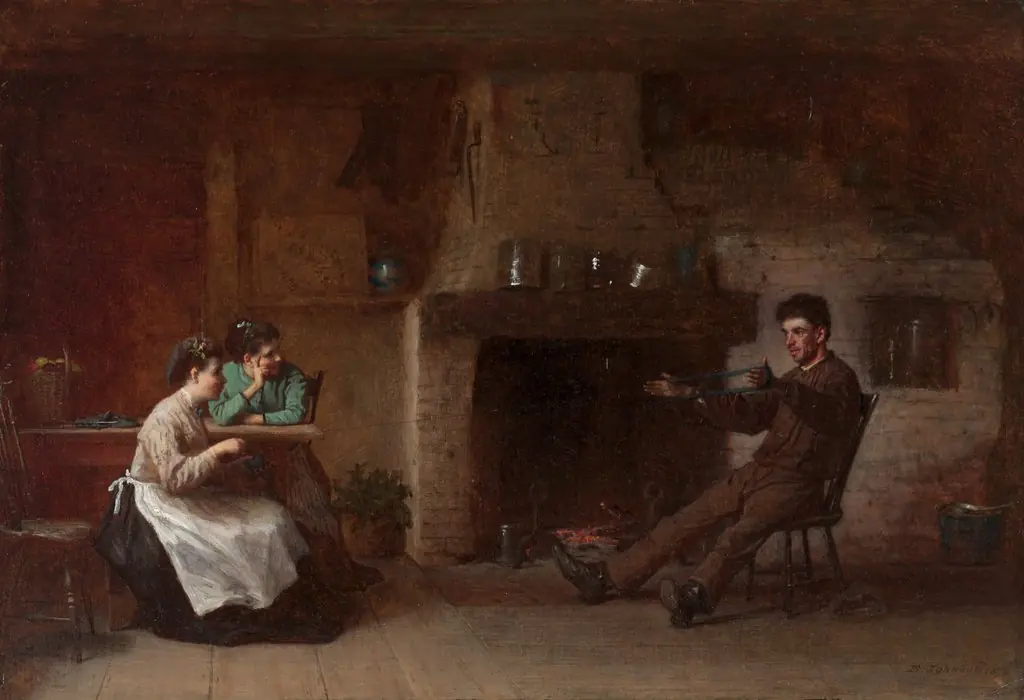 Winding Yarn (Interior of a Nantucket Kitchen)
 Bible Reading
 The Tough Story - Scene in a Country Tavern
 Bible Reading
 Kreeta Haapasalo Playing the Kantele in a Peasant Cottage
 The Refusal
 The Reprimand
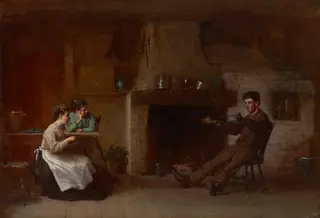 Winding Yarn (Interior of a Nantucket Kitchen)
 The Village Carpenter Bringing a Coffin for a Dead Child
 The Sailor’s Wedding