Côte des Grouettes, near Pontoise by Camille Pissarro
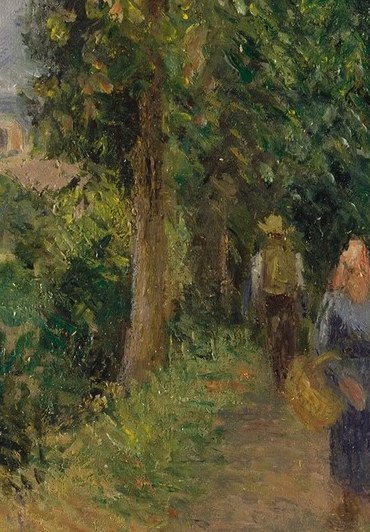
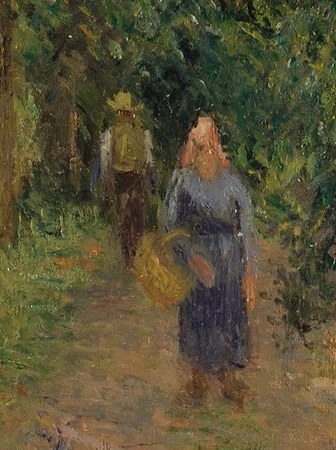
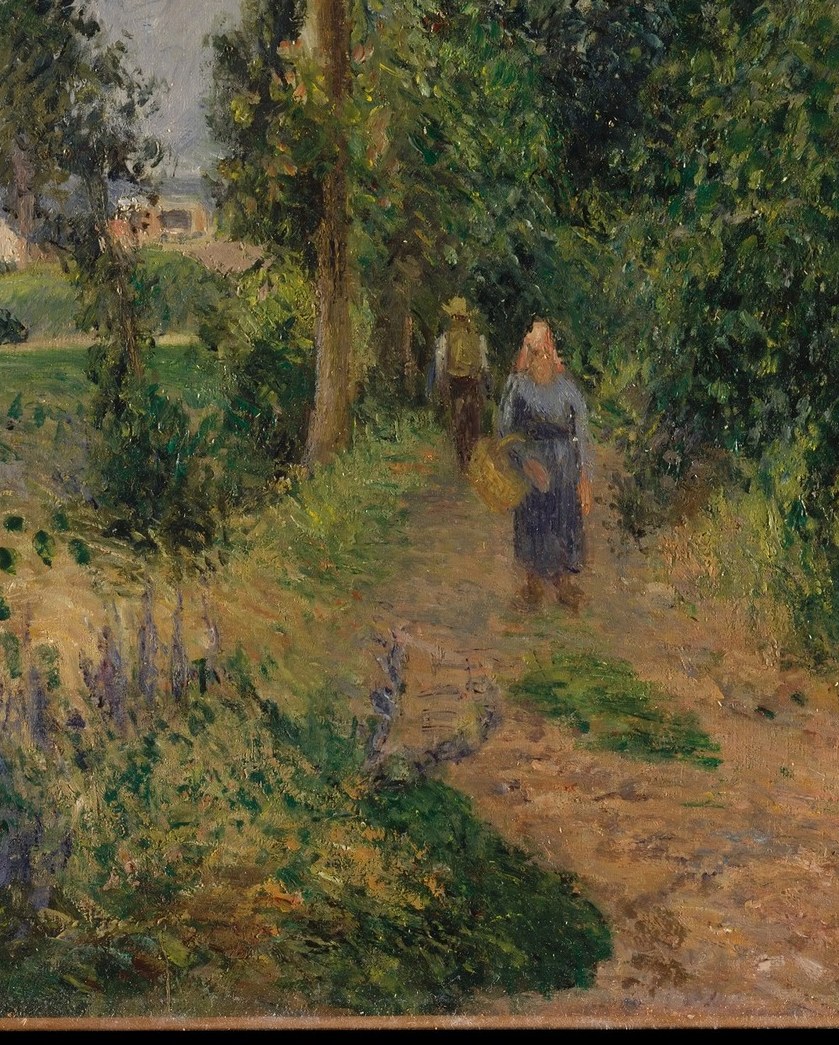
This is Côte des Grouettes, near Pontoise, painted by Camille Pissarro in 1890. It records a specific lane on the outskirts of a market town northwest of Paris, but it does more than document a place. It witnesses a working afternoon: a woman in a blue dress carrying a basket uphill, a man a few paces behind, and a road worn by cartwheels cutting through a landscape still organized by agricultural labor.
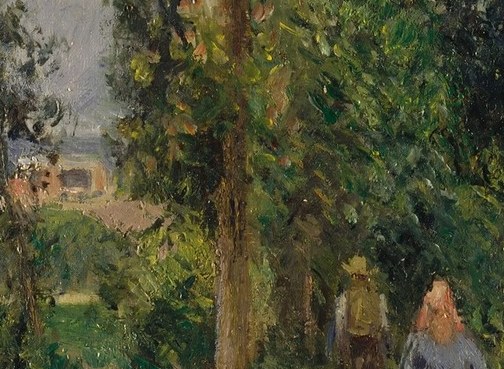
Watch where the light lands. A warm ochre patch brightens the dirt path at mid-distance. Trace it upward and you find the source: a gap in the tree canopy where cloud-diffused sunlight streams through and touches the road. Pissarro built the whole composition around that luminous column, linking sky to earth with broken brushstrokes that hold depth without hard edges. The tall poplars on the left and the dense foliage canopy on the right act as a natural frame, pushing the eye along the curving path.
Pissarro was 60 years old when he painted this. After a brief, intense period experimenting with Neo-Impressionist dots alongside Seurat and Signac, he had returned to a freer, more observational hand. He remained committed to the subject he had chosen decades earlier: rural people doing rural work. The woman's basket is not a prop. It codes her as a farmworker or market-goer, part of the agricultural economy that surrounded Pontoise. Pissarro insisted on painting individuals in natural settings, and his friend Renoir called the results revolutionary for their honest portrayal of the common person.
A faint pale rooftop in the left distance confirms that this lane is not wilderness. It belongs to an inhabited, working landscape. Stand on this path long enough and the light will shift, the woman will crest the hill, and the afternoon will go on.
Details
Transcript
France, 1890. A narrow lane outside the town of Pontoise. A woman in a long blue dress walks uphill, a dark basket in her arms. A man follows a few steps behind. They are not out for a stroll. The basket codes her: a rural worker, not a passerby, on a shared errand. The dirt path curves upward, cut by cartwheels, a working road, worn by use. A patch of warm ochre light falls across the path. Look up. The light pours through a gap in the trees: the sky linked directly to the road. Pissarro painted rural labor all his life. He called it the dignity of ordinary work.