The Sheepfold by Charles Jacque
The Sheepfold, painted by Charles Jacque in 1857, hangs at The Metropolitan Museum of Art, and almost everyone who looks at it misses the second sheep.
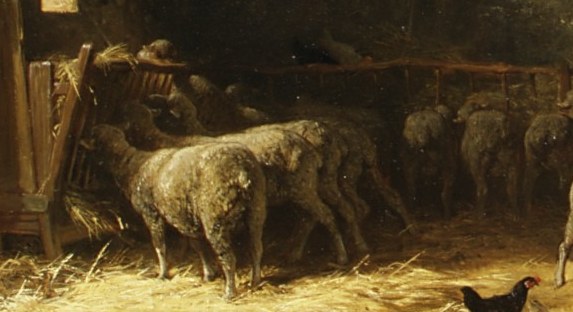
A farmer in a blue smock distributes hay inside a warm, amber-lit barn. A dense flock presses forward under a shaft of daylight. Your eye lands on the virtuoso wool in the foreground, built from short, curling strokes of impasto that make the flock feel breathing and real.
Jacque was a central figure in the Barbizon School, working alongside Jean-François Millet to elevate rural labor and naturalistic observation in French painting. He had spent seven years in the army engraving maps before turning to pastoral scenes, and you can feel the engraver's touch in every carved lock of fleece and blade of straw.
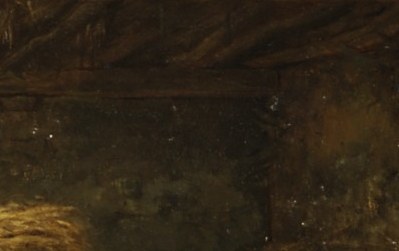
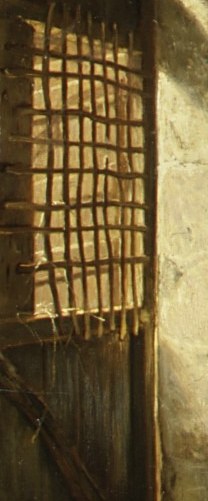
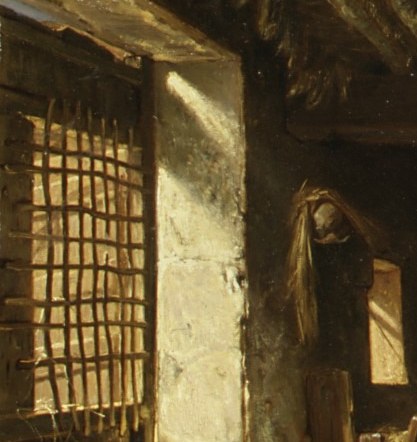
The hidden detail that changes the picture is almost invisible. Push past the bright window on the left, all the way into the compressed darkness at the edge of the barn. There, a single sheep waits, just behind the light, silent and easy to scroll past. Jacque put it there knowing most people would never stop to look.
What else might still be hiding in the corners of this 19th-century barn?
Details

Transcript
A man feeds his sheep in a barn. Nothing unusual. He worked alongside Millet in the Barbizon School. Jacque trained as an engraver. Look at the wool. Short, curling strokes build every oily lock. But you haven't looked into the dark behind the window. Another sheep stands silently at the boundary of the light.