Mrs. Noah Smith and Her Children by Ralph Earl
View the artwork: Mrs. Noah Smith and Her Children →
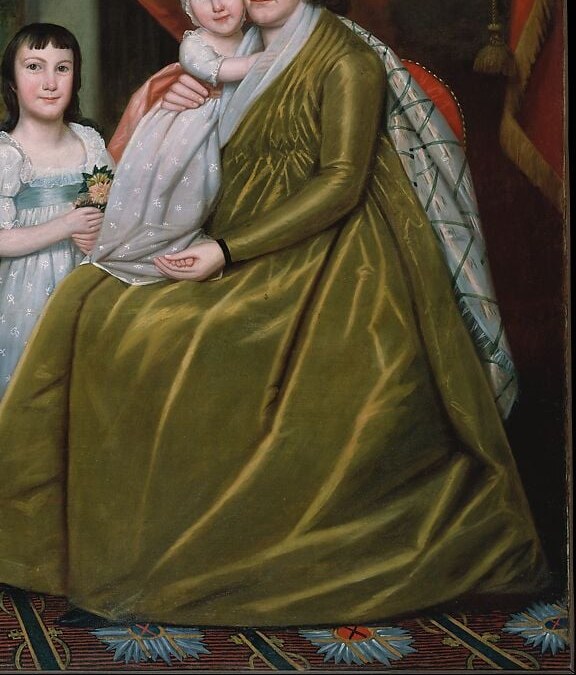
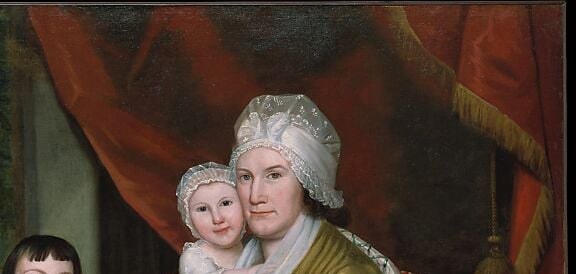
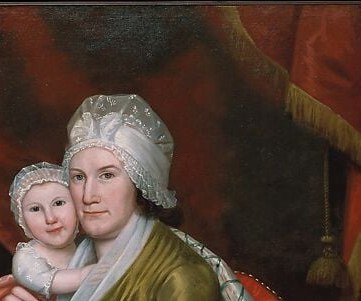
Ralph Earl painted 'Mrs. Noah Smith and Her Children' in 1798, the most ambitious single canvas of his career. At over seven feet wide, it captures Chloe Burrall Smith, wife of Vermont's chief justice, with their five children. The painting now belongs to the Metropolitan Museum of Art.
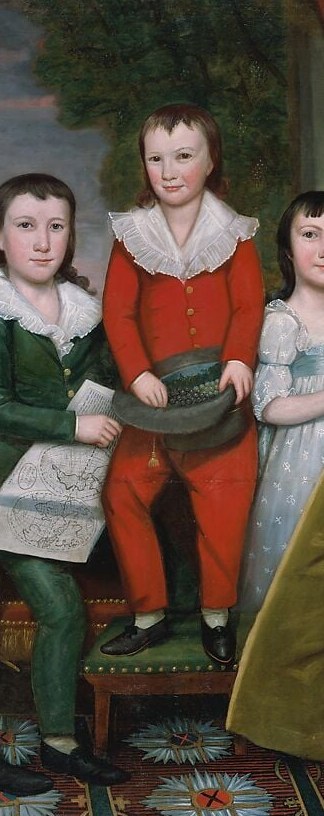
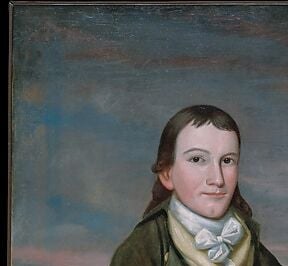
Notice what each child holds. The eldest son strikes a composed, almost adult pose. But the most deliberate symbol belongs to Daniel, second from left: he cradles a 'Map of the World' against his chest. Its dark circular form is subtle, but it was the key the family wanted viewers to hold. The map marked them as educated, globally aware participants in the new republic, not merely rural gentry.
Earl trained in London under Benjamin West during his Loyalist exile, absorbing the grand-manner conventions you can spot here (the red curtain, the landscape window, the attributes). When he returned to America, he dialed back the flash, developing the simplified linear style that pleased his New England clients. The Smith portrait is his most expansive version of that approach.
The canvas descended quietly through the family for 150 years, known mostly through a 19th-century copy. It resurfaced publicly after a 1958 sale, toured in a celebrated primitive-painting exhibition, and was gifted to the Met in 1964, where it hangs today. A whole story of a family's ambitions, folded into one boy's hands.
#arthistory #americanart #metmuseum
Details
Transcript
An 18th-century Vermont family, dressed for a portrait. The artist trained in London before returning to paint New England. His style is deliberately plain, matching his patrons' values. Each child holds an object that tells you who they are expected to become. But one detail is easy to scroll past. The boy in green holds a Map of the World. In 1798, this object signaled a family's global ambition. A Vermont judge's son studying the whole world.