The Factory Village by Julian Alden Weir
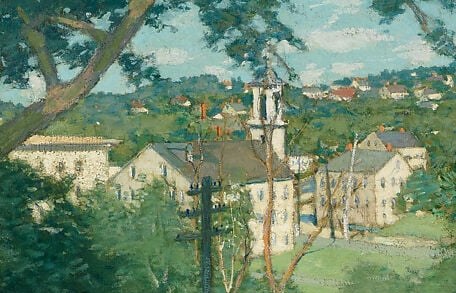
The Factory Village, painted by Julian Alden Weir in 1897, captures a specific, fleeting moment in the American landscape: the brief window when rural village and industrial mill stood side by side as uneasy neighbors. It hangs today in a museum collection, a quiet witness to an America that was about to disappear.
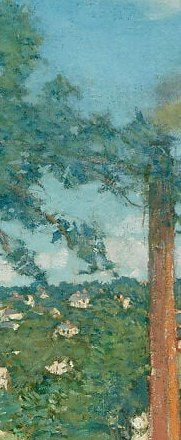
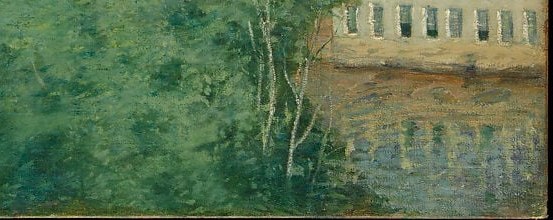
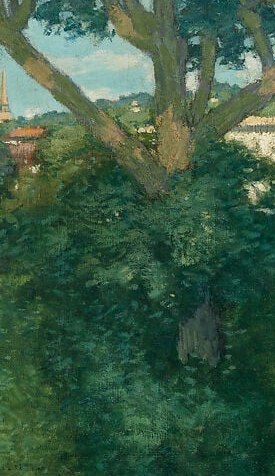
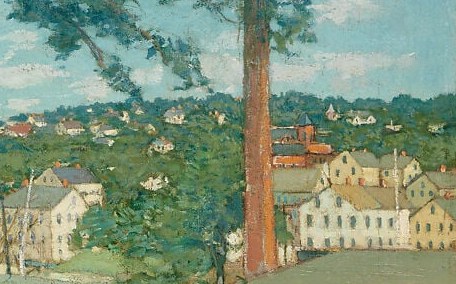
Weir gives us stillness. The red-brick chimney releases no smoke. The darkened factory windows suggest the machines are idle, the workers gone home. A massive foreground tree, older than anything built, acts as a living screen, its organic sprawl dominating the industrial geometry behind it. The white village houses still face the mill pond, their domestic scale dwarfed by the factory they now share the shore with. The water reflects the factory, but not the homes.
Weir painted this near his home in Connecticut, part of a circle of American Impressionists who had broken from the establishment to form their own group, The Ten. His handling of the evening light, the soft diffusion across brick and wood, owes something to French Impressionism, but the subject is thoroughly American: a country transforming before his eyes.
The moment Weir preserved did not last. Within a generation, scenes like this ceased to exist, the mills either failed or expanded until they swallowed the villages around them. Weir painted the pause before that outcome, and the tree at the front is the only witness still standing.
Details
Transcript
1897. A factory rises beside a quiet village. No smoke. No noise. The machines have stopped. Look at the houses. They still face the water, not the mill. The factory is reflected, but the homes are not. This massive tree is older than everything built here. The painter was a founding member of The Ten, American Impressionists who broke away together. Within a generation, scenes like this vanished from New England.