Still Life with Jar, Cup, and Apples by Paul Cézanne
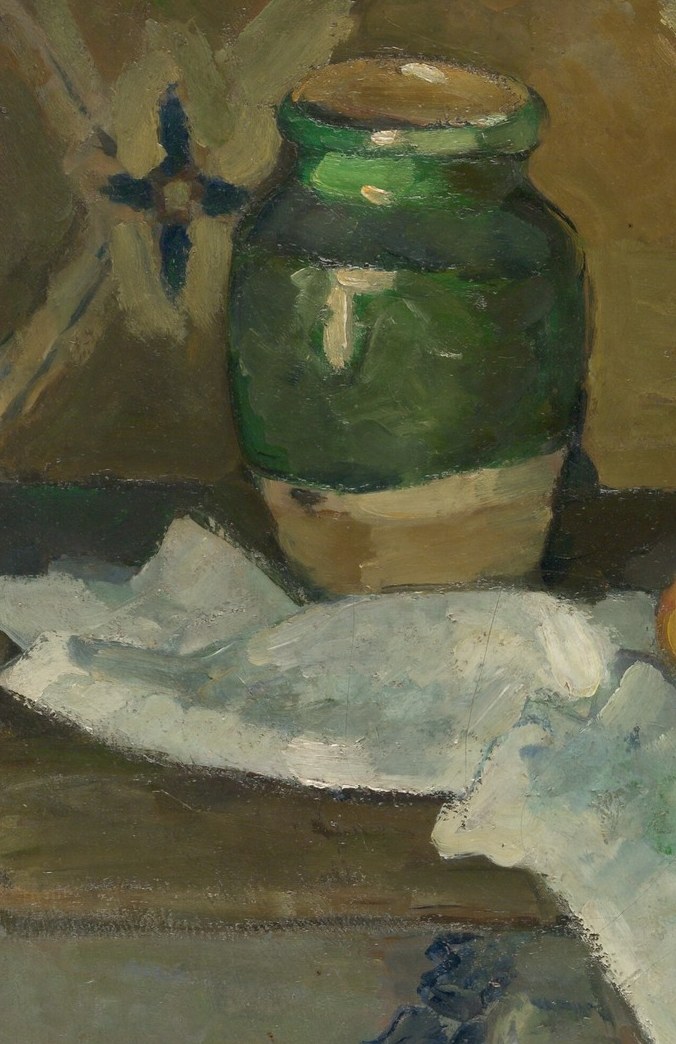
Still Life with Jar, Cup, and Apples is Paul Cézanne painting at his most radical, and the revolution is visible in a tilted table and a black hole at the top of a green jar. Made around 1889 and now in the collection of the Metropolitan Museum of Art, this canvas distills decades of his thinking about how to translate three-dimensional form onto a flat surface.
The first thing to notice is the table itself. It seems to tip forward, as if the whole scene were pressed against the picture plane. That is deliberate: Cézanne wanted you to see the tops of the apples and the side of the cup at the same time, a conceptual break from single-point perspective that opened the door to Cubism. Then look at the dark mouth of the green jar on the left, a void rendered in just a few brushstrokes, so confidently placed that it locks the vertical structure of the whole arrangement.
Cézanne built every apple from short, overlapping strokes of red, green, and yellow. He replaced traditional shadow with color modulation, letting the temperature of adjacent paint patches do the work of describing volume. The white cloth, the patterned wallpaper, everything gets treated as geometric architecture, not atmospheric backdrop.
Next time you stand before a Cézanne still life, find the darkest opening in the composition. That is where he placed the quiet center of gravity, and it holds the whole world together.
Details
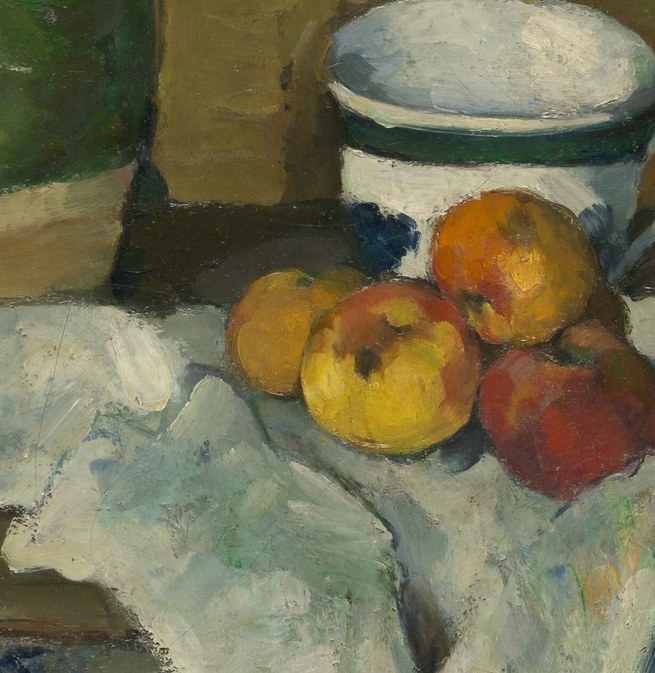
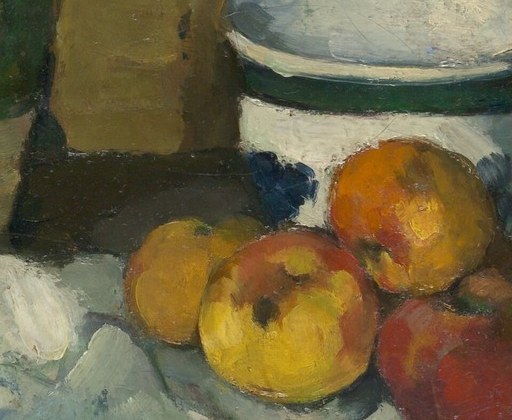
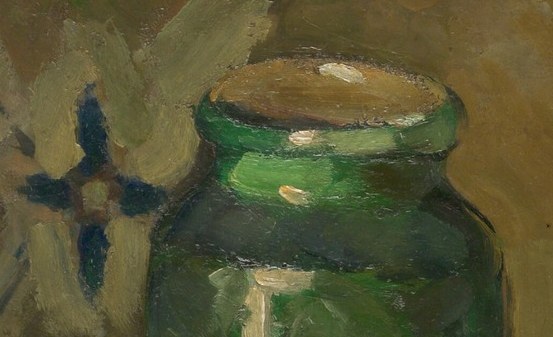
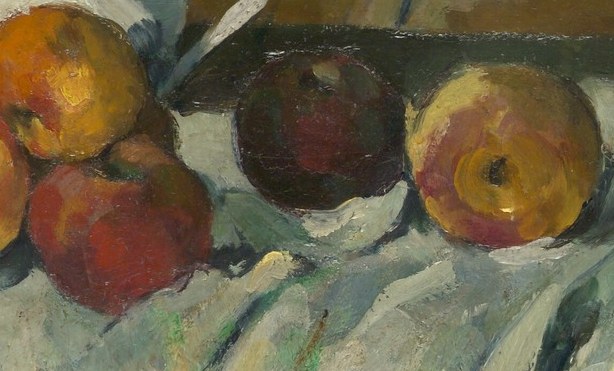
Transcript
The table looks wrong. It tilts toward you like a map spread flat. Cézanne broke perspective on purpose so you could see the apples from above and straight on at once. Look inside the white cup. A warm gray shadow pools at the bottom, hovering silence in a curved bowl. Now scan left, to the green jar. Find the dark opening at its crown. That black void anchors the vertical axis of the whole scene, a pivot of emptiness around which everything settles. Cézanne painted the rim in a few loose strokes. You can see his hand deciding where the circle closes.