Still Life: Balsam Apple and Vegetables by James Peale
This is James Peale's "Still Life: Balsam Apple and Vegetables," painted around the 1820s and now at the Metropolitan Museum of Art. For a century after his death, his best still lifes were regularly attributed to his older brother Charles Willson Peale, the more celebrated portraitist. Charles signed his name large on the canvas; James signed small, when he signed at all. Collectors and dealers saw a Peale signature and assumed it was the famous one.
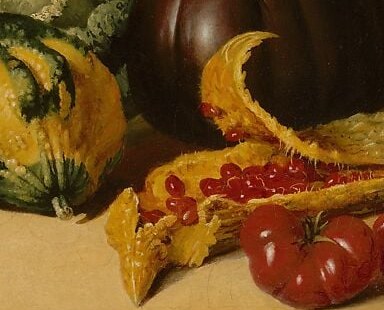
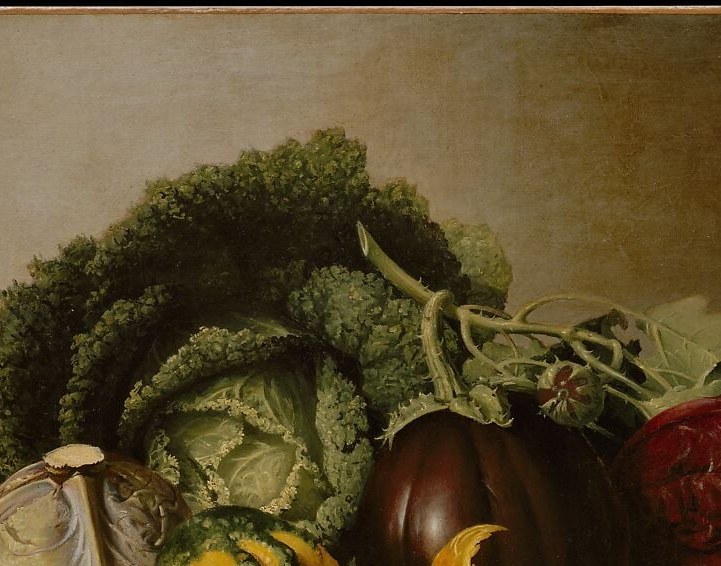
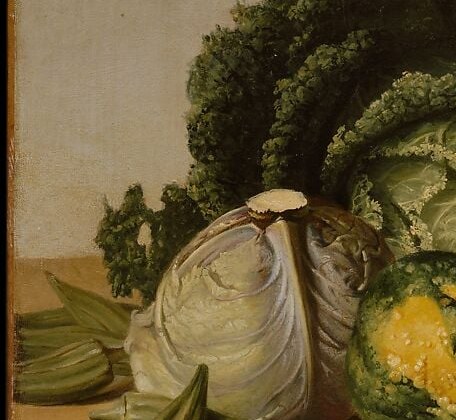
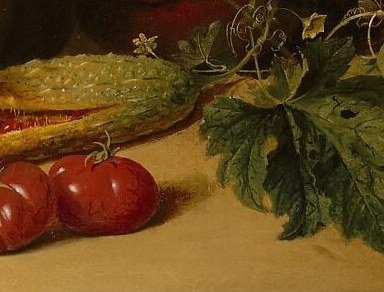
The painting itself is a quiet study of contrast and texture. The dark, ruffled Savoy cabbage anchors the upper half, its curling leaves breaking over the wooden ledge in a conscious trompe-l'oeil trick. Against it sits a bumpy balsam apple, pale and strange, the real subject and the surprise. Smooth white cabbage, striped squash, deep-gloss eggplant, and bright tomatoes build a careful baroque diagonal across the ledge. Every surface asks the eye to test whether it is paint or something solid.
The balsam apple was a genuine oddity in 1820s America. Momordica balsamina is a tropical vine, and its fruit would have been an exotic rarity on any American table of the period. Scholars believe it was grown locally in Philadelphia, possibly in a private greenhouse or hothouse, which made it a quiet marker of horticultural sophistication. Peale painted what was in front of him, ordinary garden vegetables, but slipped in this one improbable specimen as a reward for the careful viewer.
It is a painting about looking closely: at the produce, at the illusion, and at the signature that should have told the world whose hand this was. Next time you see a still life, look for the name in the corner.
Details

Transcript
This is considered the finest still life by an early American painter. The painter was James Peale. His older brother Charles was famous. Charles signed his paintings large. James signed them small. So for a century, buyers thought James's best work was Charles's. Look at the centerpiece. A balsam apple, tropical and strange. Almost nobody in 1820s America had ever seen one. It was likely grown in a private greenhouse, a quiet marvel. The painting sold for very little in his lifetime. He kept making them anyway.