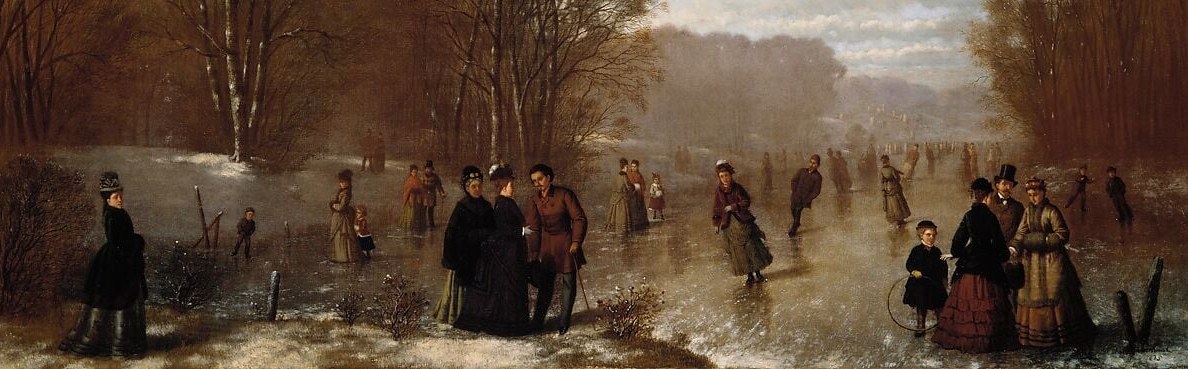
Skating on the Wissahickon by Johan Mengels Culverhouse
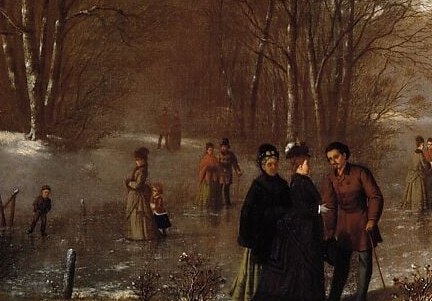
This is Johan Mengels Culverhouse's *Skating on the Wissahickon*, painted in 1875. It looks like pure Americana, a frozen creek near Philadelphia, Victorians in top hats and heavy skirts, a city at play. But the light tells a different story. Culverhouse was born in Rotterdam and trained in the Netherlands, and he brought the Dutch Golden Age with him to Pennsylvania. That pale, diffuse sky, the mirror-glow of worn ice, those are the tools of Avercamp and Van Goyen, applied to a brand-new American subject.
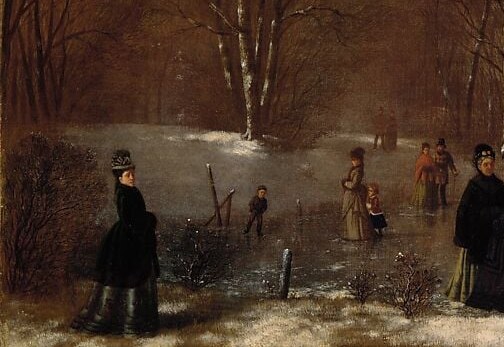
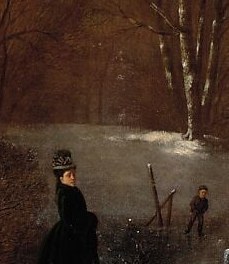
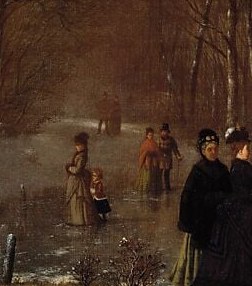
Look first at the ice itself. It is the painting's quiet miracle: a translucent, luminous ground plane reflecting the overcast sky with none of the harsh shadows a bright sun would cast. Then look up into the bare tree branches against the pale band of horizon. Culverhouse gives every twig its own anatomy, a texture no camera of 1875 could match. The crowd on the left bank watches more than it skates, a class divide between participant and spectator, marked by a wall of top hats.
Culverhouse had immigrated to the United States by the 1850s and built a career painting American landscapes and genre scenes, this creek among them. The Wissahickon was a real recreational destination for Philadelphia residents in the mid-19th century, and a frozen winter in 1875 would have drawn crowds exactly like this one. The painting is as much a social document as a landscape: the stiffness of Victorian fashion colliding with the bodily freedom of the ice.
He was an immigrant who saw an American scene through Dutch eyes and left us a record of a winter afternoon that feels both local and borrowed. What do you notice first: the people, the light, or the bare black trees?
Details
Transcript
Philadelphia, 1875. The Wissahickon Creek froze solid. The whole city seemed to have come out for the ice. Top hats and heavy skirts. Skating was a social theater. But look at how the ice glows. That pale, diffused light comes straight from the Dutch Golden Age. The painter was born in Rotterdam. He trained in the Old Master tradition. He brought that eye to a brand-new American leisure scene. An immigrant artist quietly inventing the American winter landscape.