北宋 傳趙令穰 江村秋曉圖 卷|南宋 舊傳 趙令穰 江村秋曉圖 卷|River Village in Autumn Dawn by Zhao Lingrang
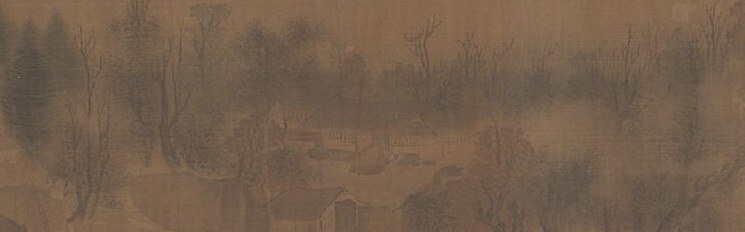
River Village in Autumn Dawn is a 13th-century Chinese handscroll, ink and color on silk, traditionally attributed to Zhao Lingrang. It is one of the earliest surviving handscrolls to depict an actual, identifiable location in China rather than a mythological or idealized landscape. The scroll unrolls right to left across a quiet river village as day breaks, and nearly everything it communicates about light, weather, and distance it achieves through restraint: the empty silk does the heaviest work.
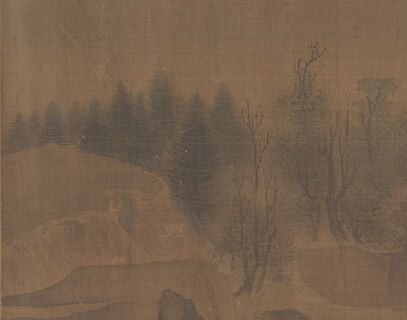
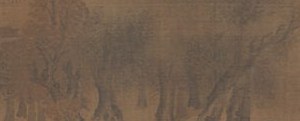
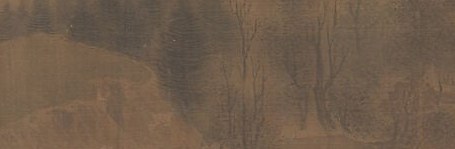
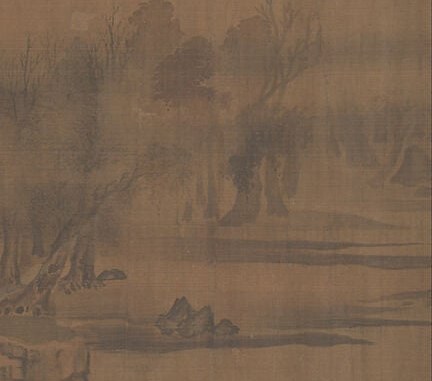
Watch the left section of the scroll. The pale mist rising from the river surface is almost entirely unpainted silk. No white pigment, no brushed cloud forms, the raw, aged silk itself reads as cool morning vapor simply because the adjacent ink tones tell your eye it should. The water, too, is a single flat wash, disturbed only by a careful wet edge where dark tree reflections bleed into it. That edge is the most painterly moment in the scroll and it arrives in one stroke.
The far shore is a handful of reserved ink marks. The technique is known in Chinese art theory as kongqi yuan, atmospheric distance achieved through graduated emptiness, and it predates Western aerial perspective by centuries. The upper sky band grades from a barely-touched ink wash into bare silk, modelling the direction of dawn light from right to left without drawing the sun or a single cloud. Even the willows drooping over the near bank, a classic seasonal motif for autumn melancholy, are built from dry strokes over wet washes to read as damp, cool morning foliage rather than solid form.
This scroll lives in the understanding that absence is a material. The painter laid down just enough ink for the world to coalesce around it, then left. The mist, the water, the distance, and the hour all sit in the silk he refused to touch. What does restraint make possible in your own work that a full description would close off?
Details
Transcript
Thirteenth century. Ink and silk, 900 years ago. Look at the left. Morning mist rising from the river. The silk there is almost untouched. The emptiness is the vapor. Now the water. A flat, pale wash and a single dark edge. That soft bleed, where tree ink meets the river, took one precise stroke. And the far shore? A few reserved marks. The rest is atmosphere. Song painters called this 'kongqi yuan.' Perspective built from absence. A whole autumn dawn, held in the silk the painter refused to touch.