Untitled by Bagta
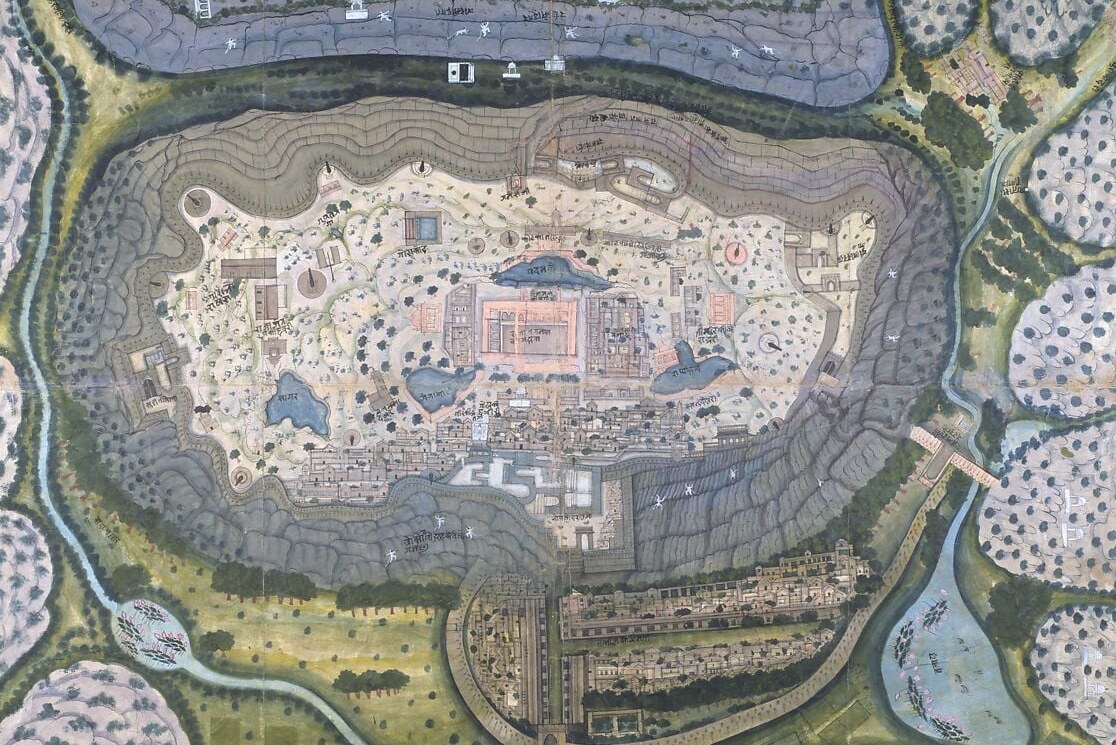
Bagta's watercolor map of Jaipur, painted around 1814, is a picture of a city at its own boundary. It records the formal grid that made Jaipur famous, one of the earliest planned cities in South Asia, and it also records the moment the city began to outgrow the plan.
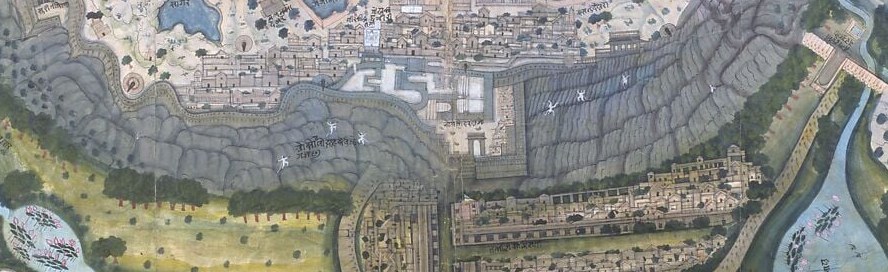
Right now, look at the southern edge of the painting, just outside the formal wall. Buildings cluster along the approach road in a loose, unplanned spill. This small detail is the heart of the painting. The founder, Sawai Jai Singh II, laid out Jaipur in 1727 with a nine-square grid inspired by cosmological texts; the wall was meant to hold the whole. By 1814, when the artist Bagta painted this, the city was already pushing past it.
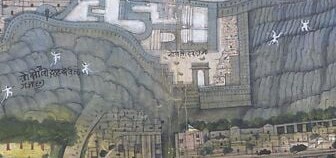
Bagta was a prominent court painter in Rajasthan, active from about 1761 until his death in 1814. His known work includes portraits, court scenes, and devotional subjects, but this unusual bird's-eye view is rare. It survives as a document of a particular moment: the pink and blue squares are still orderly inside the oval fortifications, but the painter saw what the ruler's geometry couldn't contain. Look for the tiny street figures too, he gave a pulse to a map.
A viewer who stops long enough to notice those southern houses walks away with the real story: the most orderly city on paper was already, gently, exceeding itself.
Details

Transcript
It looks like a perfect plan. Jaipur, cut from paper in 1814. A builder-prince drew the straightest streets in South Asia. He meant these walls to be the edge. But the painter saw what was already happening. Settlements spilling south, outside the fixed geometry. And where did he put the pulse of the city?