南宋 馬遠 月下賞梅圖 團扇|Viewing plum blossoms by moonlight by Ma Yuan
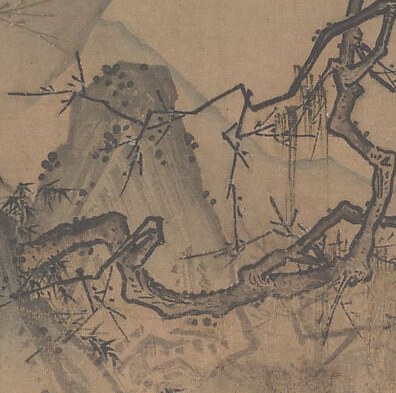
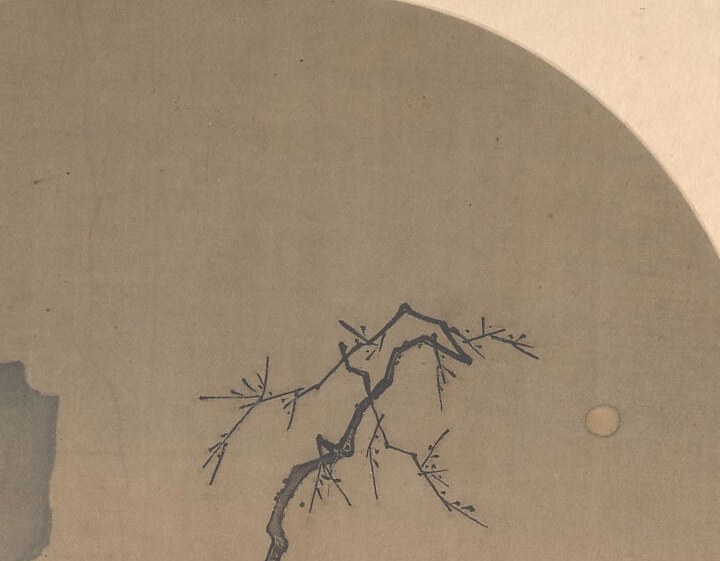
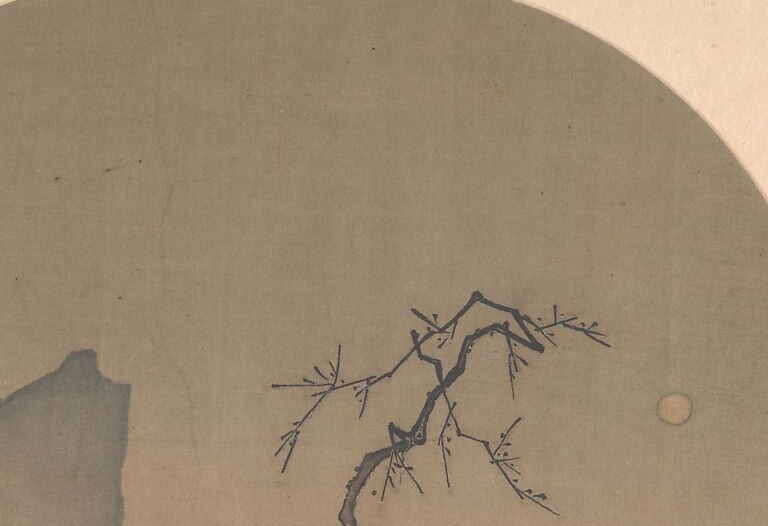
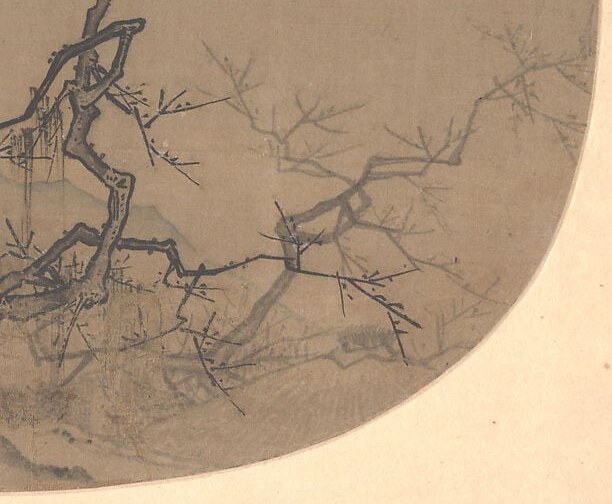
This is Ma Yuan's 'Viewing Plum Blossoms by Moonlight,' an early 13th-century fan painting now mounted as an album leaf. It is a masterwork of deliberate absence: nearly half the silk is left completely bare, yet the painting would collapse without it. The title names three things, moon, blossoms, viewing, but the moon itself is so faint that many modern viewers scroll right past it.
Find the small pale circle in the upper right sky. That tiny mark is the narrative key. Plum blossoms in full sun mean spring's arrival; seen under a cold crescent moon, they mean perseverance in darkness. The gnarled, ink-black trunk against the fragile white petals makes that contrast physical, toughness and tenderness, side by side. Below it, the solitary scholar is the sole witness.
Ma Yuan was a leading painter in the Southern Song court, co-founder with Xia Gui of the Ma-Xia school. Their signature was the 'one-corner' composition: a heavy cliff or tree mass pushed to one edge, leaving the rest of the painting as atmospheric void. Here, the unpainted silk works as moonlit mist, water, and silence all at once. The album leaf was originally a round fan, an intimate, handheld object meant for slow looking.
Nothing in this painting shouts. The moon is barely there. The man is small. The blossoms could be mistaken for snow. But once you find that moon, the whole scene shifts from a garden walk to a vigil. What other small marks might be doing more work than we notice?
Details
Transcript
At first glance, this feels like an ordinary garden view. A solitary scholar leans back and gazes upward. But look closely at what he's actually watching. Hidden in the pale silk, a tiny moon. That changes everything. Plum blossoms by daylight are spring. By moonlight, they promise survival through the harshest winter.