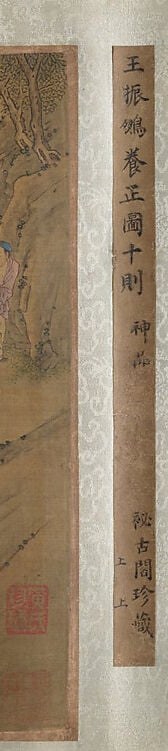
明/清 佚名 舊傳王振鵬 養正圖 卷|Family Training by After Wang Zhenpeng
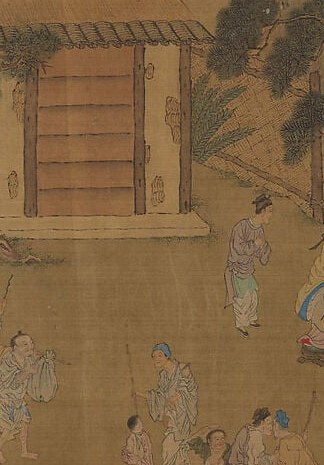
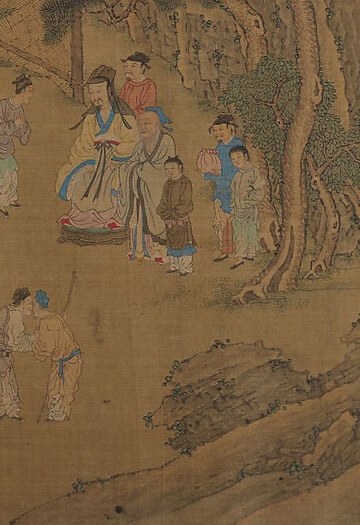
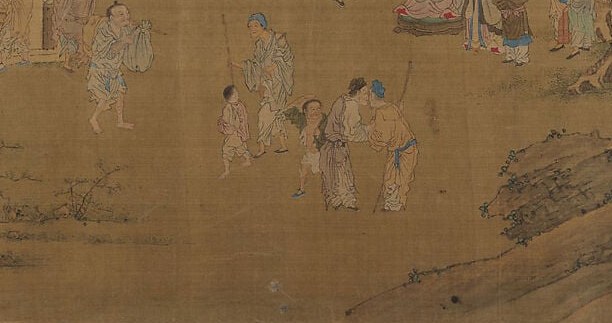
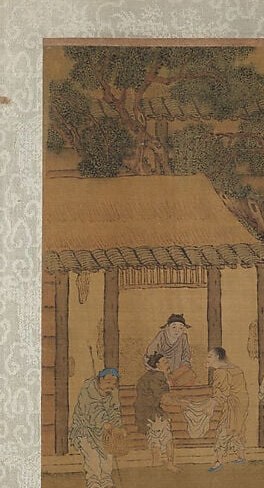
This is "Family Training" (養正圖), a ten-panel handscroll created in 1756 by an anonymous artist working in the style of the master Wang Zhenpeng. It was painted with ink and color on silk during the Qing dynasty, a period that looked back with intense reverence at the techniques of earlier painters. The scroll illustrates domestic life as a vehicle for Confucian instruction, showing mothers teaching children and fathers reading, all contained within the orderly architecture of a well-run household.
The immediate subject is the family in the garden, but the most arresting passage is not any figure. It is the trunk of the gnarled deciduous tree rising through the center of the panel. Look at the bark: the artist used a dry brush, dragged and turned across the silk, to build texture stroke by stroke. The rough outer bark, the smooth knots, and the roots are all rendered with a single brush handled at different pressures and speeds.
This technique is a direct lineage to Wang Zhenpeng, a court painter of the Yuan dynasty celebrated for his precise, controlled line in architectural and figure painting. To paint "after Wang Zhenpeng" did not mean copying a single painting. It meant internalizing a whole system of wrist movement and ink control passed down for centuries. Each twist in this tree trunk is a physical record of that training.
Four hundred years of Chinese brush practice are compressed into a few inches of bark. How does seeing that wrist movement frozen in the silk change the way you look at the rest of the scroll?
Details
Transcript
A quiet estate in 1756. A family, a garden, a lesson. The mother instructs the children in Confucian order. Look past the figures, into the bark of the old trees. Each twist of the brush leaves a different scar of texture. A single loaded brush, dragged and turned wet into dry. The artist learned this from the master Wang Zhenpeng's line. Four hundred years of ink tradition, stored in a wrist.