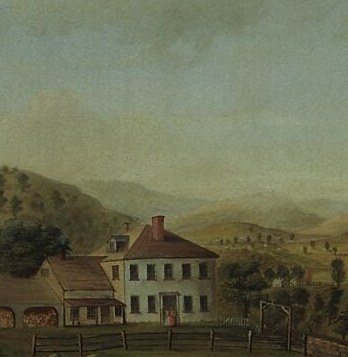
Leete Farm, West Claremont, New Hampshire by Francis Alexander
In Francis Alexander's "Leete Farm, West Claremont, New Hampshire" (ca. 1822), two figures share an ordinary day on a working farm, but one of them is so small you can scroll right past him without ever noticing.
Look for the woman in the red coat first: she's approaching the white farmhouse from the right. Then let your eye drift into the field behind her. Against the pale stubble, a second figure bends to the work of the land. Alexander painted this laborer so small and so tonally close to the ground that he nearly dissolves into the landscape.
That choice mattered. In 1822, American artists focused on portraits and historical scenes. A painting of an ordinary farm with a working body in the field was a genuine departure. Alexander included a sagging fence, a muddy track, and a cleared hillside at the upper left, all details that recorded how this land was actually lived on and used, not just admired.
"Leete Farm" is held by a private collection today. Its quiet documentary honesty helped open American art to the everyday rural world as a subject worth painting. Next time you look at a landscape, ask yourself: who is working in it?
Details


Transcript
Two figures share this quiet New Hampshire farm scene. A woman in a red coat walks toward the white farmhouse. But the artist gave this painting a second person. A laborer, working the field, nearly invisible against the stubble. In 1822, American painters almost never put a working body in a landscape. This was one of the first American paintings to show daily farm life as it actually was.